Concrete is strong under compression, but that doesn’t mean a concrete slab will never crack because, as it cures and loses moisture, it naturally shrinks. Temperature changes and other stresses can also cause movement within a slab.
Rather than hoping cracks won’t appear, concrete control joints help control where shrinkage cracking occurs.
Well-planned control joints can significantly affect the appearance and long-term performance of concrete floors, driveways, patios, and other slabs. However, you need to consider their position, spacing, depth, and timing.
In this guide, we explain how concrete control joints work, where they’re used, and common mistakes to avoid.
✅ Order ready-mix or volumetric concrete today
✅ Free, fast quote within 24 hours
✅ Call, message or complete our simple online form
Flowmix Tewkesbury: Tel: 01684 217888 Flowmix Walsall: Tel: 01922 741731
What Are Concrete Control Joints?
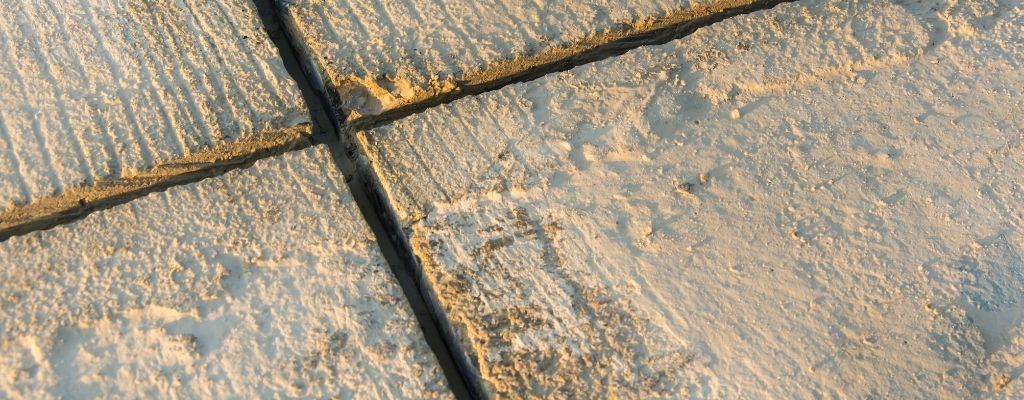
Concrete control joints are deliberately created grooves or weakened planes within a concrete slab. They encourage shrinkage cracks to form in predetermined locations rather than appearing randomly across the visible surface.
As newly placed concrete hardens and cures, it changes volume. In particular, concrete can contract as it loses moisture.
The resulting tensile stresses can eventually exceed the concrete’s tensile strength, causing a crack.
A control joint creates a planned weak point in the slab. If shrinkage causes cracking, the crack is intended to develop beneath or along the joint, where it is far less noticeable.
For this reason, control joints are sometimes also referred to as contraction joints.
Why Does Concrete Need Control Joints?
Cracking is a natural characteristic of concrete and cannot always be eliminated.
Concrete has high compressive strength but considerably lower tensile strength. When a slab is restrained while trying to shrink or move, tensile stresses can develop.
Without appropriate jointing, these stresses may be relieved through random cracking. Concrete control joints provide predetermined locations for this movement.
They’re particularly important across larger areas of concrete because the greater the dimensions of a slab, the more opportunity there is for shrinkage stresses to develop.
Control joints can also improve the appearance of finished concrete. A straight, deliberately positioned joint is generally preferable to an irregular crack running unpredictably across a floor, patio or driveway.
How Do Concrete Control Joints Work?
The principle behind a control joint is relatively simple: it creates a weakened plane within the concrete.
Instead of the entire thickness of the slab having the same resistance to cracking, the reduced section beneath the joint provides a location where a crack is more likely to form.
As the concrete contracts, tensile stresses build within the slab. When those stresses become sufficient to produce a crack, the weakened section helps determine where it occurs.
The visible groove therefore doesn’t necessarily prevent cracking. In many cases, a crack may extend through the concrete beneath it. The difference is that the cracking is controlled and directed rather than allowed to appear randomly across the surface.
Where Are Concrete Control Joints Needed?
Control joints can be used for many types of concrete slabs. Their design and spacing depend on the slab’s dimensions, thickness, reinforcement, layout, and intended use.
Concrete Floors
Large concrete floors can be particularly susceptible to shrinkage stresses because of the area involved. A planned joint layout can divide the floor into more manageable sections and provide locations for shrinkage movement.
Industrial and commercial floors may require detailed joint design because they can also be subjected to heavy traffic, machinery and substantial point loads.
Concrete Slabs
General-purpose concrete slabs can also require control joints, particularly where they cover a large area.
Slab layout is important. Long, narrow sections and irregular shapes can create areas where stresses become concentrated, increasing the likelihood of uncontrolled cracking.
Concrete Driveways
Driveways are exposed to both environmental conditions and repeated vehicle loading. You can put control joints at appropriate intervals to manage shrinkage cracking and divide a large driveway into individual panels.
Joint positioning should be part of the overall driveway design, not an afterthought after the concrete has been placed.
Patios and External Concrete
Patios, paths and other external concrete surfaces are exposed to changing temperatures and weather conditions as well as normal concrete shrinkage.
Carefully positioned joints can help manage cracking while also being incorporated into the visual layout of the finished surface.
Need Expert Advice?
Speak to the team at Flowmix Tewkesbury, Gloucestershire or Aldridge, Walsall. We are happy to help with all your concrete requirements. Contact us by email or telephone.
Flowmix Tewkesbury: Tel: 01684 217888 Flowmix Walsall: Tel: 01922 741731
How Far Apart Should Concrete Control Joints Be?
The required spacing of concrete control joints depends on several factors, including:
- Slab thickness
- Reinforcement
- Shape of the slab
- Expected loading
- Concrete specification
- Dimensions of the area
- Environmental conditions
A common rule of thumb is to place joints at about 24 to 36 times the slab thickness. For example, a 100mm slab could have control joints at approximately 2.4 to 3.6 metres.
However, rules of thumb shouldn’t replace a project-specific specification, particularly for structural, industrial or heavily loaded concrete. The shape of the resulting panels also matters.
Joint layouts generally aim to create approximately square panels rather than long, narrow sections. Irregular shapes, sharp internal corners and large differences in panel dimensions can create stress concentrations where cracking may occur.
How Deep Should Concrete Control Joints Be?
Joint depth is another important consideration. If a control joint is too shallow, it may not create a sufficiently weakened section to encourage the concrete to crack in the intended location.
A commonly used guideline is for saw-cut control joints to have a depth of at least one-quarter of the slab thickness. For a 100mm concrete slab, for example, this means a joint depth of about 25mm.
Again, treat this as general guidance rather than a specification for every project. Concrete type, reinforcement, jointing method and slab design can affect the appropriate depth.
Where a project has engineered drawings or a specified joint design, these should always take precedence.
When to Cut Control Joints
Timing can be just as important as spacing and depth. Saw-cutting concrete control joints too early can dislodge aggregate and damage the cut edges because the concrete hasn’t developed sufficient strength.
Waiting too long creates the opposite problem. As the concrete begins to shrink, stresses start developing within the slab. If the concrete reaches the point where it needs to crack before the control joints have been cut, random cracking may already have occurred.
The correct cutting window varies with the concrete mix, ambient temperature, weather conditions, and the equipment being used.
For this reason, plan joint cutting as part of concrete placement rather than treating it as something done at any convenient time afterwards.
Control Joints vs Expansion Joints
Control joints and expansion joints are often confused, but they perform different functions. A control joint primarily manages the location of shrinkage cracking within a concrete slab.
An expansion joint, or isolation joint, allows sections of concrete to move independently and can separate a slab from adjoining structures.
For example, isolation joints may be used where a concrete slab meets walls, columns or other fixed elements. Compressible material within the joint provides space for movement without transferring the same level of stress into the neighbouring structure.
A concrete project may require both types of joints, but one shouldn’t automatically substitute for the other.
Common Concrete Control Joint Mistakes
The effectiveness of control joints depends heavily on how they are designed and installed.
One common mistake is leaving too much distance between joints. Larger panels create greater opportunities for shrinkage stresses to produce cracks away from the intended joint locations.
Other common problems include:
- Cutting joints too shallow.
- Creating long, narrow concrete panels.
- Cutting joints after random cracking has already started.
- Failing to consider openings, columns or other restraints.
- Leaving joint planning until after the concrete has been poured.
- Poorly positioning joints around corners and changes in slab geometry.
- Treating every type of concrete joint as though it performs the same function.
It’s best to plan a good joint layout during the project planning stage.
✅ Order ready-mix or volumetric concrete today
✅ Free, fast quote within 24 hours
✅ Call, message or complete our simple online form
Flowmix Tewkesbury: Tel: 01684 217888 Flowmix Walsall: Tel: 01922 741731
Can Concrete Still Crack Between Control Joints?
Concrete control joints reduce the likelihood of random shrinkage cracks, but they don’t guarantee a slab will remain completely crack-free elsewhere.
Many factors affect concrete performance, including the mix used, sub-base preparation, reinforcement, slab thickness, placement, finishing, curing, loading, and environmental conditions.
Problems with any of these can contribute to cracking regardless of the joint layout.
That is why control joints should be seen as part of good concrete design and installation rather than a standalone solution for every form of cracking.
Conclusion
Good concrete work isn’t simply about ordering a strong mix and pouring it into place.
The performance of the finished slab depends on correct preparation, an appropriate concrete specification, good placement and finishing practices, effective curing and a suitable joint layout.
Planning concrete control joints before the pour allows you to consider their location, spacing, and installation method alongside the rest of the project.
For larger, structural, or heavily loaded slabs, the relevant project specification or a suitably qualified professional should determine control joint requirements.
Contact the Flowmix team to discuss your requirements and arrange your concrete delivery.
How Flowmix Can Help with Your Project
Flowmix has two plants, Gloucester and Walsall. We provide the following services (with time slots):
✅ Ready-mix concrete, mix on-site (volumetric concrete)
✅ Traditional and liquid screed.
✅ Concrete line pump Hire to reduce manual labour and associated costs, increase efficiency, reduce wastage and clean up.
✅ Interlocking concrete blocks for temporary or permanent barriers.
✅ Mini-Mix loads up to 4 cubic metres.
Flowmix holds the BSA-approved Ready Mix Concrete Kitemark KM683844, a certification that “confirms a product or service’s claim has been independently and repeatedly tested by experts” (source BSI).
Flowmix Tewkesbury: Tel: 01684 217888 Flowmix Walsall: Tel: 01922 741731
Flowmix Delivery Areas
| Tewkesbury | Walsall Plant |
| Bourton-on-the-Water | Aldridge |
| Brockworth | Barton-Under-Needwood |
| Chalford | Birmingham |
| Cheltenham | Brownhills |
| Chipping Campden | Burntwood |
| Cirencester | Burton Upon Trent |
| Droitwich Spa | Cannock |
| Evesham | Coleshill |
| Gloucester | Dudley |
| Great Malvern | Great Haywood |
| Ledbury | Lichfield |
| Newent | Norton Canes |
| Northleach | Penkridge |
| Pershore | Rugeley |
| Ross-on-Wye | Stafford |
| Stow-on-the-Wold | Tamworth |
| Stroud | Walsall |
| Tewkesbury | West Bromwich |
| Worcester | Wolverhampton |