
A concrete pour involves more than ordering concrete and getting it into place. You’ll need to work out how much you need, prepare the site and make sure everything is ready for delivery. Sorting these things out with a concrete pour checklist beforehand can save time, avoid extra costs, and help prevent problems later on.
Whether you’re laying a domestic driveway, constructing foundations, or working on a larger commercial project, a concrete pour checklist makes it easier to track everything that needs to happen.
This practical guide covers the essential checks before, during and after pouring concrete, helping you prepare your site and complete the work efficiently.
✅ Order ready-mix or volumetric concrete today
✅ Free, fast quote within 24 hours
✅ Call, message or complete our simple online form
Flowmix Tewkesbury: Tel: 01684 217888 Flowmix Walsall: Tel: 01922 741731
Concrete Pour Checklist
Before getting into the details, here’s a straightforward concrete pour checklist to help you prepare for your next concrete pour.
| Before the Pour | During the Pour | After the Pour |
| ☐ Calculate concrete quantities | ☐ Check delivery details | ☐ Protect fresh concrete |
| ☐ Confirm the correct concrete mix | ☐ Place concrete efficiently | ☐ Begin appropriate curing |
| ☐ Prepare and compact the sub-base | ☐ Compact the concrete | ☐ Prevent premature loading |
| ☐ Inspect formwork and reinforcement | ☐ Check levels and falls | ☐ Clean tools and equipment |
| ☐ Check delivery vehicle access | ☐ Finish the surface correctly | ☐ Dispose of waste responsibly |
| ☐ Review the weather forecast | ||
| ☐ Organise labour and equipment |
Before the Pour: Your Concrete Pour Checklist
Good preparation can make the difference between a straightforward concrete delivery and a stressful day on site. Complete these seven checks off the concrete pour checklist before your concrete arrives.
#1: Calculate How Much Concrete You Need
Ordering the correct quantity of concrete is one of the first steps in planning a pour and should be top of your concrete pour checklist.
Too little concrete can interrupt the work and potentially create unwanted construction joints. Ordering too much increases costs and leaves you with surplus material to manage.
For a rectangular area, calculate the volume by multiplying the length, width and depth.
Length × Width × Depth = Volume in cubic metres (m³)
Remember that excavations aren’t always perfectly uniform. Uneven ground, depth variations, and irregular shapes can affect the final quantity required.
Our online concrete calculator can help you estimate your requirements before ordering, or you can call the Flowmix team for advice.
Flowmix Tewkesbury: Tel: 01684 217888 Flowmix Walsall: Tel: 01922 741731
#2: Choose the Correct Concrete Mix
Equally important on your concrete pour checklist is getting the right mix. The correct specification depends on several factors, including the intended use, expected loads, environmental exposure and any structural requirements.
For example, concrete for domestic paths may have different performance requirements than concrete for agricultural flooring or heavily trafficked commercial areas.
Before ordering, establish the intended application, any specified concrete strength or designated mix and workability requirements for placing and compaction.
Check exposure conditions, including potential frost or chemical attack and any additional project specifications.
If you’re unsure which mix to order, discuss the application with your concrete supplier before arranging delivery.
#3: Prepare the Ground and Sub-Base
The ground beneath a concrete slab needs to provide adequate support for the intended structure.
Poor ground preparation can contribute to settlement, cracking and uneven surfaces, even when the concrete itself has been correctly specified.
Before pouring:
- Excavate to the required depth.
- Install the specified sub-base material.
- Compact the sub-base using appropriate equipment.
- Remove vegetation, loose material and unsuitable soil.
- Install any specified membranes, insulation or other layers.
- Check that the finished levels allow for the required concrete thickness.
Exact preparation requirements depend on the type of construction and the ground conditions.
For structural work, follow the project design and any relevant engineering recommendations rather than relying on general rules of thumb.
#4: Inspect Formwork and Reinforcement
Formwork holds freshly placed concrete in position until it has developed sufficient strength.
Before the delivery arrives, inspect the formwork to ensure it is secure, correctly aligned and adequately supported.
Check that the levels, dimensions, and falls are correct, the formwork is firmly fixed and properly braced, and the reinforcement is positioned according to the specification.
Also check that suitable spacers and supports maintain the required concrete cover, joints are sufficiently tight to prevent excessive loss of cement paste, and any specified joints, ducts or embedded components are correctly positioned.
Fresh concrete places considerable pressure on formwork, particularly during placement and compaction. Inadequate support can cause movement, leakage or even formwork failure.
#5: Check Site Access for Concrete Delivery
Concrete delivery vehicles need safe access to the designated unloading point. Restricted entrances, narrow roads, overhead cables, low branches and unsuitable ground conditions can all cause difficulties.
Before booking your delivery, consider height restrictions or overhead obstructions, whether the entrance is wide enough for the delivery vehicle and whether there is sufficient room for safe vehicle manoeuvring.
Assess the distance between the unloading point and the pour location and decide whether a concrete pump or other placing equipment is required. Finally, assess the condition and load-bearing suitability of access roads and standing areas.
If the concrete cannot be discharged directly into the required area, make suitable arrangements to transport it from the delivery vehicle.
Discuss potential access problems with your concrete supplier in advance. It’s much easier to resolve them before the concrete is on its way.
#6: Check the Weather Forecast
Weather conditions can significantly affect concrete placement, finishing and curing.
Cold weather can slow strength development and increase the risk of freeze damage. Hot, dry or windy conditions can cause moisture to evaporate too quickly, increasing the risk of plastic shrinkage cracking.
Heavy rain can also damage the surface of freshly placed concrete.
Check the forecast before scheduling the pour and consider whether additional precautions are needed. Remember that weather protection may be required after placement as well as during the pour itself.
Need Expert Advice?
Speak to the team at Flowmix Tewkesbury, Gloucestershire or Aldridge, Walsall. We are happy to help with all your concrete requirements. Contact us by email or telephone.
Flowmix Tewkesbury: Tel: 01684 217888 Flowmix Walsall: Tel: 01922 741731
#7: Organise Labour, Tools and Equipment
Once concrete arrives, the placing operation needs to proceed without unnecessary delays.
Make sure everyone involved understands their responsibilities and that sufficient labour is available for the size and complexity of the job.
Equipment requirements vary, but may include:
- Floats and finishing equipment.
- Measuring and levelling equipment.
- Protective coverings and curing materials.
- Appropriate personal protective equipment.
- Shovels, rakes and suitable concrete placing tools.
- Concrete vibrators or other suitable compaction tools.
- Wheelbarrows or other concrete transportation equipment.
Wet concrete is highly alkaline and can cause serious skin burns. Workers should wear suitable waterproof gloves, protective footwear, eye protection and clothing that prevents prolonged skin contact.
Make sure a suitable first-aid and washing facility is available.
During the Pour: Essential Checks
For the final stage on the concrete pour checklist, attention turns to receiving, placing and finishing the concrete.
#8: Check the Concrete Delivery
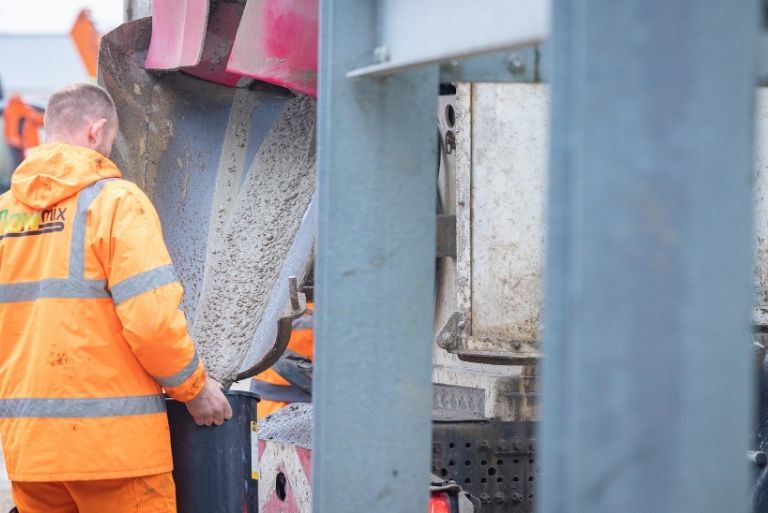
When the concrete arrives, check the delivery documentation before discharge begins.
Confirm that the delivery matches the order, including the specified mix, quantity and any additional requirements.
If you have concerns about the concrete’s appearance, consistency, or specification, raise them with the supplier before proceeding.
Avoid adding water to improve workability without appropriate authorisation. Uncontrolled water additions can alter the water-cement ratio and adversely affect strength, durability and other concrete properties.
#9: Place Concrete Efficiently
Place concrete in a planned sequence that allows work to progress steadily.
Distribute the material as close as practical to its final position to minimise unnecessary movement and reduce the risk of segregation.
For bigger jobs, work out where you’ll start pouring and how you’ll move across the area so the work can continue without unnecessary stops.
Concrete won’t stay workable indefinitely. How long you’ve got depends on the mix, the weather and delivery conditions, so make sure it’s placed and compacted before it becomes too stiff to work with.
#10: Compact and Level the Concrete
Proper compaction helps remove trapped air and ensures the concrete surrounds reinforcement and fills the formwork.
Inadequate compaction can leave voids, honeycombing and weak areas.
Depending on the application and concrete specification, compaction may involve mechanical vibration or other suitable methods. However, excessive vibration can cause segregation, so use equipment correctly.
Once the concrete has been placed and compacted, check the required levels and falls.
Carry out surface finishing at the appropriate stage. Finishing too early, particularly while bleed water remains on the surface, can contribute to surface defects.
After the Pour: Finishing and Curing Checklist
The work doesn’t end when the concrete has been levelled and finished. Freshly placed concrete needs suitable protection and curing to develop its intended performance.
#11: Protect Freshly Placed Concrete
Fresh concrete needs protecting from the weather. Heavy rain can spoil the surface, while frost can cause damage before the concrete has hardened properly. Hot, dry conditions can also cause problems if the concrete loses moisture too quickly and starts to crack.
Keep people and equipment off the area until it’s safe to use.
#12: Allow Adequate Curing Time
Curing helps concrete retain the moisture and temperature conditions needed for cement hydration and strength development.
Without suitable curing, concrete may be more susceptible to surface cracking, reduced durability and inadequate strength development.
Common curing methods include maintaining moisture with suitable coverings, applying an appropriate curing compound, using wet coverings where suitable, and protecting the concrete from excessive temperature changes.
The required curing period depends on the concrete specification, weather conditions and intended application.
Although concrete is commonly associated with a 28-day strength assessment, this doesn’t mean every slab is ready for full loading after exactly 28 days.
Likewise, a surface becoming hard enough to walk on doesn’t necessarily mean it can safely support vehicles, stored materials or construction equipment.
#13: Clean Equipment and Manage Concrete Waste
Finally, the last on the concrete pour checklist and no less important. Once the pour is complete, clean tools and equipment before residual concrete hardens.
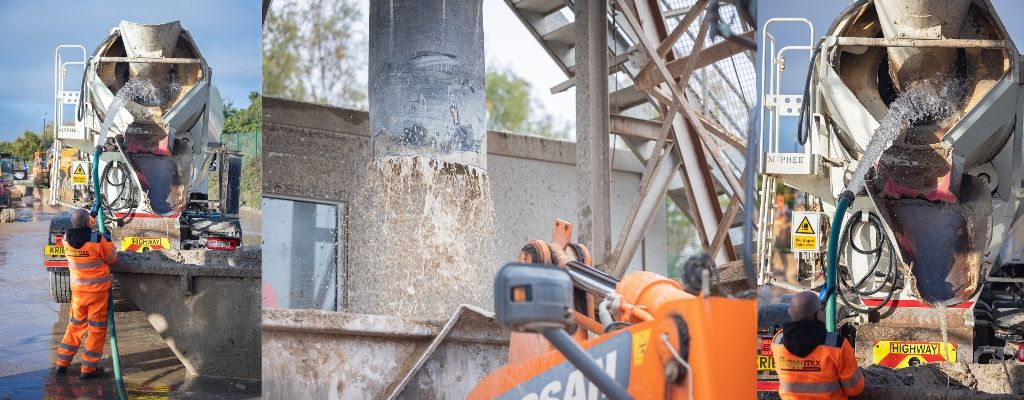
However, manage concrete washout water carefully. Never assume that washout water can be safely discharged into a surface water drain.
Fresh concrete residue and washout water are typically highly alkaline and can harm the environment if discharged into drains, watercourses or unprotected ground.
Use a designated, suitably contained washout area and arrange appropriate disposal or recovery of waste materials.
How Flowmix Can Help with Your Project
Flowmix has two plants, Gloucester and Walsall. We provide the following services (with time slots):
✅ Ready-mix concrete, mix on-site (volumetric concrete)
✅ Traditional and liquid screed.
✅ Concrete line pump Hire to reduce manual labour and associated costs, increase efficiency, reduce wastage and clean up.
✅ Interlocking concrete blocks for temporary or permanent barriers.
✅ Mini-Mix loads up to 4 cubic metres.
Flowmix holds the BSA-approved Ready Mix Concrete Kitemark KM683844, a certification that “confirms a product or service’s claim has been independently and repeatedly tested by experts” (source BSI).
Flowmix Tewkesbury: Tel: 01684 217888 Flowmix Walsall: Tel: 01922 741731
Flowmix Delivery Areas
| Tewkesbury | Walsall Plant |
| Bourton-on-the-Water | Aldridge |
| Brockworth | Barton-Under-Needwood |
| Chalford | Birmingham |
| Cheltenham | Brownhills |
| Chipping Campden | Burntwood |
| Cirencester | Burton Upon Trent |
| Droitwich Spa | Cannock |
| Evesham | Coleshill |
| Gloucester | Dudley |
| Great Malvern | Great Haywood |
| Ledbury | Lichfield |
| Newent | Norton Canes |
| Northleach | Penkridge |
| Pershore | Rugeley |
| Ross-on-Wye | Stafford |
| Stow-on-the-Wold | Tamworth |
| Stroud | Walsall |
| Tewkesbury | West Bromwich |
| Worcester | Wolverhampton |