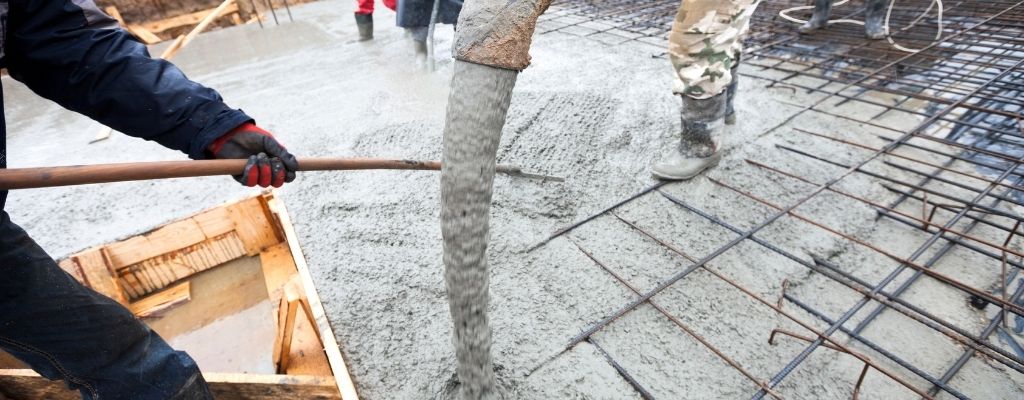
Fresh concrete contains air. Some gets into the mix during batching, and some gets trapped during transport and pouring. Unless you remove it, that air can remain as small holes or larger voids once the concrete hardens.
Concrete compaction helps release trapped air while settling the concrete into the space being filled.
✅ Order ready-mix or volumetric concrete today
✅ Free, fast quote within 24 hours
✅ Call, message or complete our simple online form
Flowmix Tewkesbury: Tel: 01684 217888 Flowmix Walsall: Tel: 01922 741731
What Is Concrete Compaction?
Concrete compaction is simply about removing trapped air from freshly placed concrete because when concrete is poured into formwork, it doesn’t automatically fill every little space,
Some concrete mixes deliberately contain tiny air bubbles to meet specific performance requirements. That is entrained air, not the air pockets we’re trying to remove during compaction.
Why Concrete Compaction Is Important
If air gets trapped in the concrete, it can cause problems later on. You may notice it as soon as the formwork comes off – perhaps a few holes, a rough section or patches where the aggregate is showing through.
Methods Of Compacting Concrete
There are multiple methods of compacting concrete. The depth of the concrete, amount of reinforcement, shape of the pour and consistency of the mix all make a difference.
Poker Vibrators
Poker vibrators are widely used for foundations, walls, columns and reinforced concrete. The vibrating head is inserted directly into the fresh concrete, letting the mix settle while trapped air rises to the surface.
Surface Vibration
Surface vibration suits relatively shallow concrete. Vibrating beams and screeds work from the top of the pour and are commonly used on slabs. In addition to compacting the concrete, some equipment can help with levelling.
Hand Compaction
Small or shallow pours can sometimes be compacted without mechanical vibration.
Need Expert Advice?
Speak to the team at Flowmix Tewkesbury, Gloucestershire or Aldridge, Walsall. We are happy to help with all your concrete requirements. Contact us by email or telephone.
Flowmix Tewkesbury: Tel: 01684 217888 Flowmix Walsall: Tel: 01922 741731
Common Concrete Compaction Mistakes
- Missing Areas of the Pour: If the poker is inserted wherever there’s convenient space, you can miss areas between insertion points.
- Using the Vibrator to Move Concrete: A poker will move wet concrete, but that doesn’t mean you should use it to push concrete around the pour.
- Removing The Poker Too Quickly: The concrete needs time to settle behind the vibrator as it’s removed.
- Over-Vibrating: Too much vibration can increase the risk of segregation.
- Adding Extra Water: Adding water can weaken the mix.
What Happens If Concrete Isn’t Compacted Properly
Honeycombing is an obvious sign of a problem. Instead of a solid concrete surface, areas of coarse aggregate remain visible, with gaps where mortar should have filled the gaps between the stones.
Poor concrete compaction isn’t the only possible cause. Concrete can also honeycomb if it’s difficult to place or lacks suitable workability.
Other problems associated with inadequate compaction include air pockets and internal voids, reduced strength, increased permeability, poor surface finish, gaps around reinforcement and weak or inconsistent areas
Does All Concrete Need the Same Level of Compaction?
A shallow slab differs greatly from a deep foundation. Light reinforcement differs from a section with closely spaced bars. Concrete consistency varies too.
All of these things affect how easily the concrete can settle into place.
Self-compacting concrete is another case entirely. It’s specifically designed to flow into formwork and around reinforcement without conventional mechanical vibration.
For ordinary concrete, the method and amount of compaction should suit the particular mix and the job being carried out.
Conclusion
Concrete compaction can only do so much if the concrete is difficult to place in the first place.
Concrete workability needs to suit the job. Closely spaced reinforcement or complicated formwork may call for concrete that can move more readily into restricted areas.
How Flowmix Can Help with Your Project
Flowmix has two plants, Gloucester and Walsall. We provide the following services (with time slots):
✅ Ready-mix concrete, mix on-site (volumetric concrete)
✅ Traditional and liquid screed.
✅ Concrete line pump Hire to reduce manual labour and associated costs, increase efficiency, reduce wastage and clean up.
✅ Interlocking concrete blocks for temporary or permanent barriers.
✅ Mini-Mix loads up to 4 cubic metres.
Flowmix holds the BSA-approved Ready Mix Concrete Kitemark KM683844, a certification that “confirms a product or service’s claim has been independently and repeatedly tested by experts” (source BSI).
Flowmix Tewkesbury: Tel: 01684 217888 Flowmix Walsall: Tel: 01922 741731
Flowmix Delivery Areas
| Tewkesbury | Walsall Plant |
| Bourton-on-the-Water | Aldridge |
| Brockworth | Barton-Under-Needwood |
| Chalford | Birmingham |
| Cheltenham | Brownhills |
| Chipping Campden | Burntwood |
| Cirencester | Burton Upon Trent |
| Droitwich Spa | Cannock |
| Evesham | Coleshill |
| Gloucester | Dudley |
| Great Malvern | Great Haywood |
| Ledbury | Lichfield |
| Newent | Norton Canes |
| Northleach | Penkridge |
| Pershore | Rugeley |
| Ross-on-Wye | Stafford |
| Stow-on-the-Wold | Tamworth |
| Stroud | Walsall |
| Tewkesbury | West Bromwich |
| Worcester | Wolverhampton |