
Choosing the right screed is an important part of any flooring project, particularly when thermal insulation, acoustic performance or underfloor heating are involved. Floating screed is a popular solution for both residential and commercial buildings, providing a stable floor surface while allowing insulation to be incorporated beneath it.
But what exactly is floating screed, how does it differ from other screed systems, and which type should you use?
In this guide, we’ll explain how floating screed works, its benefits, installation considerations and how liquid screeds such as Gyvlon and Cemfloor can be used in floating floor constructions.
✅ Order liquid screed today
✅ Free, fast quote within 24 hours
✅ Call, message or complete our simple online form
Flowmix Tewkesbury: Tel: 01684 217888 Flowmix Walsall: Tel: 01922 741731
What Is Floating Screed?
Floating screed is a layer of screed installed over thermal or acoustic insulation rather than being bonded directly to the structural subfloor.
The insulation separates the screed from the base beneath it, creating a floating floor construction. This arrangement can improve thermal efficiency, reduce sound transmission and provide a suitable foundation for underfloor heating systems.
There are three main types of screed construction:
- Bonded screed: Applied directly to a prepared structural substrate, creating a bond between the screed and the base.
- Unbonded screed: Separated from the structural substrate by a membrane, without an insulating layer beneath it.
- Floating screed: Installed over a suitable layer of thermal or acoustic insulation, with perimeter isolation to separate it from surrounding walls and other fixed elements.
Floating screed is commonly specified for new-build homes, extensions, apartments and commercial properties where insulation and floor performance are important considerations.
What Are the Benefits of Floating Screed?
Floating screed offers several advantages, particularly when combined with modern liquid screed systems.
#1: Improved Thermal Insulation
One of the main benefits of floating screed is its compatibility with floor insulation.
A layer of insulation beneath the screed helps prevent heat escaping through the floor, keeping rooms warmer and reducing energy waste. How well it works depends on the insulation material, its thickness and how it’s fitted.
#2: Better Acoustic Performance
Floating floor constructions can help reduce impact sound transmission between floors.
By separating the screed from the structural base using suitable acoustic insulation, vibrations caused by footsteps and other impacts can be reduced.
This makes floating screed particularly useful in apartments, multi-storey buildings and properties where sound insulation is a priority.
However, the acoustic performance depends on the complete floor construction, including the insulation and perimeter detailing.
#3: Ideal for Underfloor Heating
Floating screed is frequently used with water-based underfloor heating systems.
The insulation beneath the screed helps limit downward heat loss, while the screed surrounds the heating pipes and transfers heat into the room.
Liquid screeds are particularly well suited to this application because their flowing consistency allows them to surround the pipework with minimal voids, supporting efficient heat transfer.
#4: Suitable for Different Floor Constructions
Floating screed can be incorporated into a wide range of floor designs, from domestic ground floors to commercial developments.
The insulation and screed specification can be adapted to suit different thermal, acoustic and loading requirements.
#5: Potential for Reduced Screed Thickness
Certain liquid screed systems can be installed at lower minimum thicknesses than conventional sand and cement screeds.
This can be beneficial where floor build-up height is restricted, although the permitted thickness depends on the product, insulation characteristics and expected loading.
Floating Screed and Underfloor Heating
Underfloor heating is one of the most common reasons for specifying floating screed.
In a typical installation, thermal insulation is laid over the structural floor, followed by the underfloor heating pipework and screed.
The insulation helps direct heat upwards into the room rather than allowing excessive heat loss into the structure below.
The screed then acts as a heat transfer medium, distributing warmth across the floor surface.
For best results from underfloor heating, the insulation needs to be suitable for the job, the pipes must be securely fixed, and there needs to be enough screed to cover them. Movement joints also need to be correctly positioned, and the heating system should be commissioned following the manufacturer’s guidelines.
Liquid screed works particularly well with underfloor heating because it flows around the pipes, fills gaps, and allows heat to spread evenly across the floor.
Need Expert Advice?
Speak to the team at Flowmix Tewkesbury, Gloucestershire or Aldridge, Walsall. We are happy to help with all your concrete requirements. Contact us by email or telephone.
Flowmix Tewkesbury: Tel: 01684 217888 Flowmix Walsall: Tel: 01922 741731
Can Liquid Screed Be Used as Floating Screed?
Yes. Liquid screeds are widely used in floating floor constructions, offering several advantages over traditional sand and cement screeds.
Their flowing consistency makes them easier to place across larger areas, while their self-compacting properties help produce a smooth, level surface.
Flowmix supplies two established, top-quality liquid screed products: Gyvlon and Cemfloor.
Both can be used in suitable floating floor applications, although their composition, installation requirements and performance characteristics differ.
Gyvlon Liquid Screed
Gyvlon is a calcium sulphate-based liquid screed commonly used in residential and commercial flooring projects.
Its flowing properties make it particularly suitable for floating floors and underfloor heating installations.
It flows well around underfloor heating pipes and has good thermal conductivity for efficient heat transfer. It has reduced shrinkage compared with traditional sand and cement screeds and can allow thinner screed installations, subject to specification. Finally, it is efficient for placement across large floor areas.
Gyvlon can be an effective choice where underfloor heating performance, floor levels and installation efficiency are important.
However, as a calcium sulphate-based screed, it has specific moisture, drying, and floor-covering preparation requirements that must be followed.
Cemfloor Liquid Screed
Cemfloor is a cement-based liquid screed designed for use in a variety of floor constructions, including floating floors.
It combines the flowing characteristics of liquid screed with the properties of a cementitious material.
Its benefits include:
- Low shrinkage characteristics.
- Good flow and compaction around heating pipes.
- Suitable for use with underfloor heating systems.
- Reduced installation thicknesses in suitable applications.
- Compatibility with a range of floor finishes when correctly prepared.
Because Cemfloor is cement-based, it has different moisture and floor-covering compatibility characteristics than calcium sulphate screeds.
It can be a practical option for projects where a cement-based liquid screed is preferred.
Gyvlon vs Cemfloor: Which Is Better for Floating Screed?
Both products can provide excellent results when correctly specified and installed.
The main difference is their composition: Gyvlon is calcium sulphate-based, while Cemfloor is cement-based.
The most suitable product depends on factors such as floor construction, intended use, drying requirements, floor finishes and site conditions.
If you’re unsure which screed is best for your project, call the Flowmix team for guidance.
Flowmix Tewkesbury: Tel: 01684 217888 Flowmix Walsall: Tel: 01922 741731
How Thick Does Floating Screed Need to Be?
Floating screed thickness is an important consideration because the screed must distribute loads effectively over the insulation beneath it.
Unlike bonded screed, floating screed does not receive direct support from the structural substrate. Its performance therefore depends on the screed thickness, strength, insulation properties and expected floor loading.
The required thickness will vary according to:
- The anticipated floor loads.
- The compressibility of the insulation.
- Whether underfloor heating is installed.
- The type and strength of screed being used.
- The diameter and positioning of heating pipes.
- The manufacturer’s minimum thickness requirements.
Liquid screeds such as Gyvlon and Cemfloor may allow thinner floor constructions than traditional sand and cement screed, but permitted depths vary by product and application.
Always refer to the relevant manufacturer’s technical guidance rather than assuming a standard thickness will suit every floating floor.
How Is Floating Screed Installed?
Correct preparation is essential for a successful floating screed installation.
Although the precise process varies depending on the screed system, the main stages generally include the following.
Step 1: Prepare the Structural Subfloor
The structural floor should be sound, clean and suitable for the proposed insulation and screed construction. Address any significant unevenness or defects before the insulation is installed.
Step 2: Install the Insulation
Thermal or acoustic insulation boards are laid according to the floor specification. Boards should be fitted closely together and adequately supported to minimise movement.
The insulation must have sufficient compressive strength and suitable deformation characteristics for the expected loads.
Step 3: Install Perimeter Strips and Membranes
Compressible perimeter strips are installed around walls, columns and other fixed elements to isolate the screed and accommodate movement.
A separating membrane is usually laid over the insulation, with the joints sealed to stop liquid screed seeping into any gaps.
Step 4: Install Underfloor Heating
If underfloor heating is being fitted, the pipes need to be securely fixed in position so they don’t move when the screed is poured. The system should also be pressure-tested before screeding starts.
Step 5: Check Levels and Screed Depth
With underfloor heating, the screed must be deep enough to cover the pipes to the manufacturer’s recommended depth.
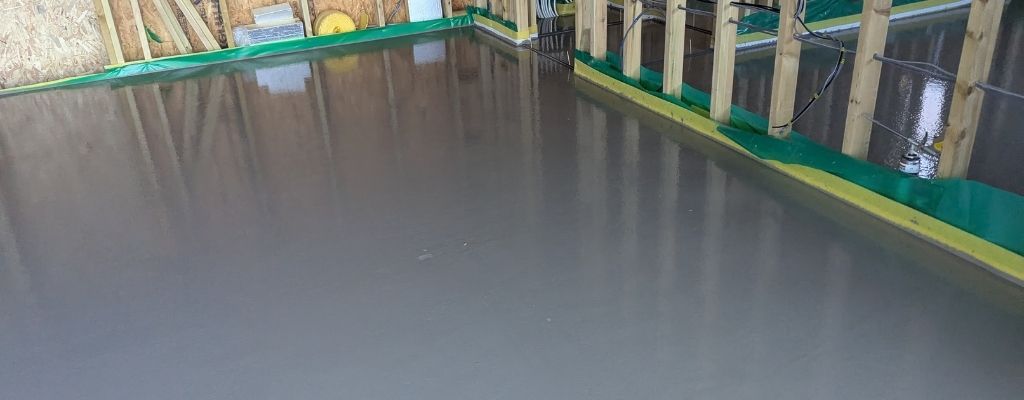
Step 6: Place the Liquid Screed
Liquid screed is delivered to the site and placed by the appointed screeding contractor.
Its flowing consistency helps it spread across the prepared floor area and achieve the required levels.
Flowmix supplies and delivers Gyvlon and Cemfloor liquid screeds, helping contractors obtain the materials required for their flooring projects.
Step 7: Allow the Screed to Cure and Dry
After installation, protect the screed and allow it to cure and dry in accordance with the manufacturer’s instructions.
Drying conditions, ventilation, screed thickness, and site temperature can all affect how long it takes before floor coverings can be installed.
Moisture testing and any necessary surface preparation should be completed before the final flooring is laid.
Choosing the Right Floating Screed for Your Project
Floating screed is a versatile flooring solution that can provide thermal insulation, acoustic benefits and effective integration with underfloor heating.
For many projects, liquid screed offers additional advantages through its flowing consistency, efficient placement and suitability for modern floor construction methods.
Both Gyvlon and Cemfloor can be used in appropriate floating screed applications, but the correct choice depends on the project’s technical requirements.
Factors such as insulation type, screed depth, loading, underfloor heating and intended floor finish should all be considered before selecting a product.
How Flowmix Can Help with Your Project
Flowmix has two plants, Gloucester and Walsall. We provide the following services (with time slots):
✅ Ready-mix concrete, mix on-site (volumetric concrete)
✅ Traditional and liquid screed.
✅ Concrete line pump Hire to reduce manual labour and associated costs, increase efficiency, reduce wastage and clean up.
✅ Interlocking concrete blocks for temporary or permanent barriers.
✅ Mini-Mix loads up to 4 cubic metres.
Flowmix holds the BSA-approved Ready Mix Concrete Kitemark KM683844, a certification that “confirms a product or service’s claim has been independently and repeatedly tested by experts” (source BSI).
Flowmix Tewkesbury: Tel: 01684 217888 Flowmix Walsall: Tel: 01922 741731
Flowmix Delivery Areas
| Tewkesbury | Walsall Plant |
| Bourton-on-the-Water | Aldridge |
| Brockworth | Barton-Under-Needwood |
| Chalford | Birmingham |
| Cheltenham | Brownhills |
| Chipping Campden | Burntwood |
| Cirencester | Burton Upon Trent |
| Droitwich Spa | Cannock |
| Evesham | Coleshill |
| Gloucester | Dudley |
| Great Malvern | Great Haywood |
| Ledbury | Lichfield |
| Newent | Norton Canes |
| Northleach | Penkridge |
| Pershore | Rugeley |
| Ross-on-Wye | Stafford |
| Stow-on-the-Wold | Tamworth |
| Stroud | Walsall |
| Tewkesbury | West Bromwich |
| Worcester | Wolverhampton |