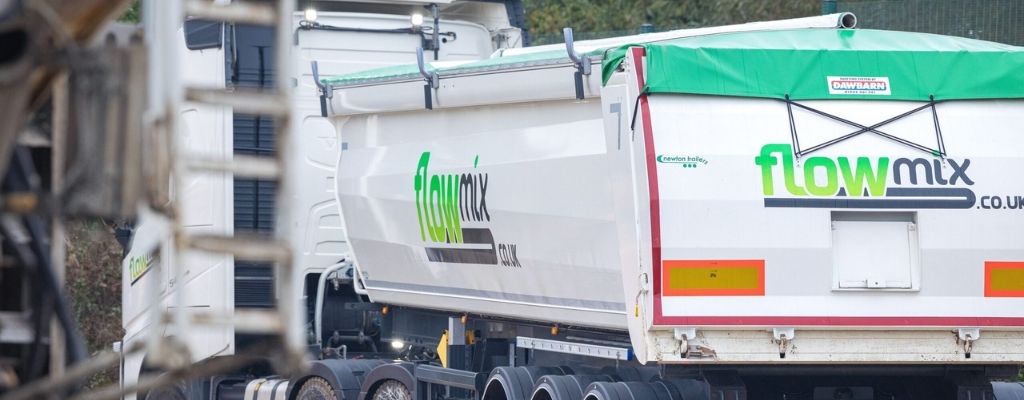
When ordering concrete, getting the right quantity, mix, and delivery arrangements can make a huge difference to your project. But what if your concrete could be mixed fresh on site, rather than prepared before the delivery vehicle sets off?
That’s exactly what volumetric mixers do.
Whether you’re laying foundations for a home extension, installing a driveway or managing a busy commercial construction site, volumetric concrete offers a flexible, practical alternative to traditional ready-mixed concrete delivery.
Let’s take a closer look at how volumetric mixers work and why they’re becoming such a useful option for construction projects of all sizes.
✅ Order ready-mix or volumetric concrete today
✅ Free, fast quote within 24 hours
✅ Call, message or complete our simple online form
Flowmix Tewkesbury: Tel: 01684 217888 Flowmix Walsall: Tel: 01922 741731
What Are Volumetric Mixers?
Volumetric mixers are specialist concrete delivery vehicles that carry the individual ingredients needed to produce concrete in separate compartments.
Instead of transporting a pre-mixed load, the vehicle carries materials such as cement, aggregates, and water, which are measured and combined on site.
The concrete is produced using an on-board mixing system, with the ingredients dispensed according to the required mix specification.
This means the concrete is freshly mixed as needed, rather than travelling to the site already mixed.
Volumetric mixers are sometimes described as mobile concrete batching plants because they effectively bring the concrete production process directly to the customer.
And that offers some significant advantages.
#1: Fresh Concrete Mixed On-Site
One of the biggest benefits of volumetric concrete is freshness.
With traditional drum-mixed concrete deliveries, the concrete is generally mixed at a batching plant before being transported to the site. The hydration process begins when cement and water combine, so delivery and waiting times must be managed carefully.
Volumetric mixers work differently.
Because the ingredients remain separate during transport, the vehicle can mix the concrete when it reaches the site.
This provides greater control over when mixing begins and reduces the time between mixing and placement.
It’s particularly useful for projects where travel distances, site conditions or unpredictable schedules could otherwise create challenges.
Freshly mixed concrete doesn’t eliminate the need for proper placement, finishing, and curing, but it can offer valuable flexibility during delivery.
#2: Order the Concrete You Need and Reduce Waste
Estimating concrete quantities isn’t always an exact science. Even with careful measurements, uneven ground, varying excavation depths, and unexpected site conditions can affect how much concrete a project actually needs.
With ready-mix concrete deliveries, you order a predetermined volume. If the estimate is too high, you may end up with surplus concrete. If it’s too low, you may need an additional delivery.
Volumetric mixers offer a more flexible approach.
Because concrete is produced on-site, the quantity can be adjusted during the delivery, within the vehicle’s available capacity and the supplier’s operating arrangements.
This means customers can potentially avoid paying for significant quantities of unused concrete.
It also helps reduce unnecessary material waste, which is good news for both project budgets and the environment.
#3: Greater Flexibility for Different Concrete Mixes
Not every construction project needs the same type of concrete. The specifications for a domestic garden path may differ greatly from those needed for structural foundations, industrial flooring, or commercial groundworks.
Volumetric mixers produce concrete according to programmed mix designs, with the equipment proportioning the ingredients.
Depending on the mixer’s capabilities and the materials carried, it can produce different concrete specifications in a single delivery.
For example, a project may require one concrete specification for foundations and another for a separate non-structural application.
Rather than automatically requiring separate deliveries, a volumetric mixer can accommodate both requirements, provided the mixes are compatible with the available materials and equipment.
All mix specifications must be agreed in advance and meet the project’s technical requirements.
This versatility makes volumetric concrete particularly useful for sites with varied concrete needs.
#4: Less Risk of Running Short
Few things are more frustrating on a construction site than discovering you’re just short of the concrete needed to finish the job. An unexpected shortage can interrupt work, leave contractors waiting and create additional logistical challenges.
Volumetric concrete delivery can help reduce that risk.
Because concrete is produced on demand, the operator can adjust the quantity supplied if the job requires more than originally estimated, as long as enough materials remain on the vehicle.
Of course, volumetric mixers don’t have an unlimited supply of concrete, so it’s still important to provide a realistic estimate when booking.
But having some flexibility during delivery can make a considerable difference when the unexpected happens.
Need Expert Advice?
Speak to the team at Flowmix Tewkesbury, Gloucestershire or Aldridge, Walsall. We are happy to help with all your concrete requirements. Contact us by email or telephone.
Flowmix Tewkesbury: Tel: 01684 217888 Flowmix Walsall: Tel: 01922 741731
#5: Potential Cost Savings
One of the most appealing benefits of volumetric concrete is the potential to reduce unnecessary costs.
The savings don’t necessarily come from a lower price per cubic metre. Instead, they can result from using the concrete more efficiently.
For example:
- Less overordering: Concrete can be produced according to the quantity actually required, subject to the supplier’s charging arrangements.
- Reduced waste: Fewer surplus materials may mean lower disposal costs.
- Fewer additional deliveries: If the mixer has sufficient capacity, it can accommodate small quantity variations during the same visit.
- Greater flexibility: Fresh on-site mixing can help manage timing challenges associated with concrete delivery.
For builders, contractors and homeowners, these advantages can contribute to better cost control.
As with any concrete delivery method, the overall price depends on the quantity, specification, location and individual project requirements.
#6: A More Efficient Approach to Concrete Delivery
Construction projects rarely run entirely according to plan. Unexpected ground conditions, access restrictions, changing requirements and delays involving other trades can all affect the working day.
Because the concrete is mixed on site, there’s no need to transport a full load of already-mixed concrete from the batching plant.
This can reduce pressure associated with transporting and discharging concrete within a limited time after mixing.
It also allows the operator to produce concrete as required, within the equipment’s operating limits.
However, once the concrete has been mixed, it still needs to be placed, finished and cured correctly. The result is a delivery method that can work particularly well for projects where efficiency and flexibility are priorities.
#7: Volumetric Concrete Can Help Reduce Environmental Waste
Sustainability is an increasingly important consideration across the construction industry.
Concrete production has an environmental impact, particularly because of the emissions associated with cement manufacturing.
While volumetric mixers don’t eliminate these impacts, they can reduce waste from overordering.
By producing concrete to the required quantity, there’s potentially less unused material to dispose of at the end of a job.
This can also reduce the need for additional deliveries caused by small shortfalls, provided the mixer has enough material available to meet the final requirement.
Remember that the overall environmental performance of concrete delivery depends on several factors, including vehicle efficiency, transport distances, mix design, and material consumption.
Nevertheless, reducing unnecessary concrete waste benefits projects of all sizes.
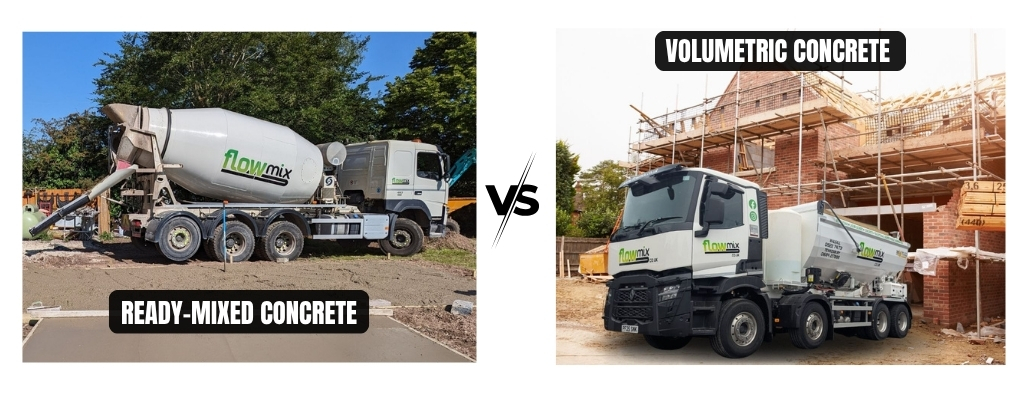
Volumetric Mixers vs Ready-Mix Concrete: What’s the Difference?
Both volumetric and traditional ready-mix concrete have their place in construction. The main difference is where and when you mix the concrete.
Traditional ready-mix concrete can be highly efficient for large, continuous pours when quantities and specifications are known.
Volumetric concrete is particularly attractive when quantities may vary, different mixes are required, or fresh concrete offers a practical advantage.
What Types of Projects Benefit from Volumetric Concrete?
Volumetric concrete suits a wide range of domestic and commercial applications, provided the equipment can meet the required specification.
Common examples include:
- Home extensions: Concrete foundations and other structural elements where the correct specification is essential.
- Driveways and patios: Projects where exact quantities may be affected by ground levels and preparation.
- Footings and foundations: Particularly where excavation dimensions vary.
- Commercial groundworks: Sites requiring flexible concrete quantities or different specifications.
- Agricultural projects: Concrete for suitable bases, yards and other structures.
- Small and medium-sized construction jobs: Where avoiding unnecessary concrete waste is especially beneficial.
For larger projects, volumetric mixers can also complement other concrete supply arrangements, depending on site requirements and delivery capacity.
Volumetric mixers offer greater flexibility in concrete quantities, fresh on-site mixing, and the potential to reduce unnecessary waste.
For contractors, that can mean more control over material requirements and fewer complications when site conditions don’t quite match the original plan.
For homeowners, it can make ordering concrete for smaller projects more straightforward, particularly when calculating the exact quantity is difficult.
Whether you’re planning foundations, a driveway, a concrete slab or a larger development, our team can help you discuss your concrete requirements and arrange a suitable delivery.
How Flowmix Can Help with Your Project
Flowmix has two plants, Gloucester and Walsall. We provide the following services (with time slots):
✅ Ready-mix concrete, mix on-site (volumetric concrete)
✅ Traditional and liquid screed.
✅ Concrete line pump Hire to reduce manual labour and associated costs, increase efficiency, reduce wastage and clean up.
✅ Interlocking concrete blocks for temporary or permanent barriers.
✅ Mini-Mix loads up to 4 cubic metres.
Flowmix holds the BSA-approved Ready Mix Concrete Kitemark KM683844, a certification that “confirms a product or service’s claim has been independently and repeatedly tested by experts” (source BSI).
Flowmix Tewkesbury: Tel: 01684 217888 Flowmix Walsall: Tel: 01922 741731
Flowmix Delivery Areas
| Tewkesbury | Walsall Plant |
| Bourton-on-the-Water | Aldridge |
| Brockworth | Barton-Under-Needwood |
| Chalford | Birmingham |
| Cheltenham | Brownhills |
| Chipping Campden | Burntwood |
| Cirencester | Burton Upon Trent |
| Droitwich Spa | Cannock |
| Evesham | Coleshill |
| Gloucester | Dudley |
| Great Malvern | Great Haywood |
| Ledbury | Lichfield |
| Newent | Norton Canes |
| Northleach | Penkridge |
| Pershore | Rugeley |
| Ross-on-Wye | Stafford |
| Stow-on-the-Wold | Tamworth |
| Stroud | Walsall |
| Tewkesbury | West Bromwich |
| Worcester | Wolverhampton |