When building foundations for a house extension, retaining wall, commercial building or other structure, one question often arises: do you need rebar concrete footings?
Concrete is a strong material, but it’s less resistant to tensile forces, which can cause cracking and movement over time. This is where steel reinforcement, commonly known as rebar, comes into play.
Understanding when rebar concrete footings are required can help ensure your foundations remain strong and stable, supporting loads placed upon them for many years to come.
✅ Order ready-mix or volumetric concrete today
✅ Free, fast quote within 24 hours
✅ Call, message or complete our simple online form
Flowmix Tewkesbury: Tel: 01684 217888 Flowmix Walsall: Tel: 01922 741731
What Is Rebar and Why Is It Used in Concrete Footings?
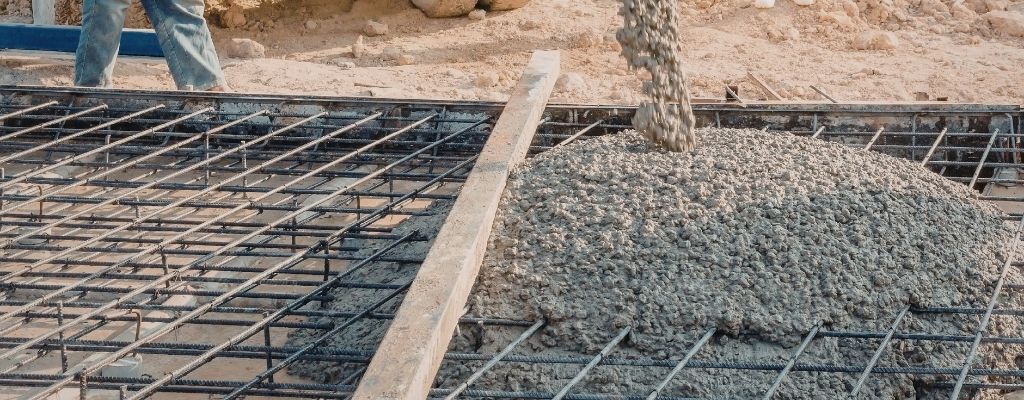
Rebar, short for reinforcing bar, is a steel bar or mesh placed within concrete before it is poured. The purpose of rebar is to strengthen the concrete and improve its ability to withstand tension, bending and ground movement.
Concrete provides excellent compressive strength, while steel reinforcement provides tensile strength. That helps create a solid foundation capable of handling greater loads.
For many projects, rebar concrete footings provide additional structural security and long-term durability.
When Are Rebar Concrete Footings Required?
The need for reinforcement depends on several factors, including the size of the structure, soil conditions and foundation design.
#1: Heavy Structural Loads
Structures that place significant weight on foundations often require reinforced footings, such as retaining walls, house extensions, new-build homes, industrial structures and commercial buildings. Rebar concrete footings help distribute loads evenly and reduce the risk of structural movement.
#2: Poor Ground Conditions
Not all ground conditions provide ideal support for foundations.
Reinforcement may be recommended where ground movement is more likely, such as clay soils, made-up or filled ground, areas prone to settlement and sites with varying soil conditions.
#3: Wide Or Deep Foundations
If a site requires wide or deep foundations, reinforcement improves strength and ensures the footing performs as intended.
#4: Structural Engineer Specifications
Many larger residential and commercial projects involve foundation designs prepared by a structural engineer.
If reinforcement is specified in the design, rebar concrete footings must be installed in accordance with the engineer’s drawings and Building Control requirements.
Need Expert Advice?
Speak to the team at Flowmix Tewkesbury, Gloucestershire or Aldridge, Walsall. We are happy to help with all your concrete requirements. Contact us by email or telephone.
Flowmix Tewkesbury: Tel: 01684 217888 Flowmix Walsall: Tel: 01922 741731
When Rebar May Not Be Necessary
Not every foundation requires steel reinforcement. In some cases, plain concrete footings may be sufficient, particularly for:
- Small garden walls
- Lightweight sheds
- Minor landscaping structures
- Projects built on stable ground conditions
However, the suitability of traditional concrete should always be confirmed by the project designer, the structural engineer, or the Building Control officer.
Common Mistakes When Installing Rebar Concrete Footings
Correct installation is just as important as using reinforcement in the first place.
- Placing Rebar Directly on the Ground: Rebar should be supported with suitable spacers or chairs to ensure it sits within the concrete rather than resting on the soil.
- Insufficient Concrete Cover: Steel reinforcement requires adequate concrete cover to protect it from moisture and corrosion.
- If rebar is too close to the surface, it may rust over time, potentially weakening the foundation.
- Incorrect Spacing:Reinforcement must be spaced according to the design specifications. Incorrect spacing can reduce the effectiveness of the reinforcement and compromise structural performance.
- Poorly Secured Reinforcement: Rebar should be properly tied and secured before concrete is poured to prevent movement during placement.
- Using Inconsistent Concrete:The quality of the concrete itself is critical. Variations in mix quality can affect strength, durability and overall performance.
Building Regulations and Reinforced Foundations
Building Regulations do not automatically require all foundations to contain reinforcement.
The need for rebar concrete footings depends on:
- Structural loads
- Ground conditions
- Foundation dimensions
- Engineer specifications
- Building Control requirements
Before starting any project, it is important to ensure the foundation design complies with current regulations and any recommendations provided by your structural engineer.
Conclusion
Rebar concrete footings provide valuable additional strength, stability and durability for many construction projects. Although not all footings require reinforcement, structures subjected to heavy loads and challenging ground conditions often benefit from reinforced concrete.
By combining correctly installed reinforcement with high-quality ready-mix concrete, you can create foundations built to perform for decades.
If you’re planning a residential, commercial or industrial project, Flowmix can supply reliable ready-mix concrete and concrete pumping services to help ensure your foundations are built on solid ground.
How Flowmix Can Help with Your Project
Flowmix has two plants, Gloucester and Walsall. We provide the following services (with time slots):
✅ Ready-mix concrete, mix on-site (volumetric concrete)
✅ Traditional and liquid screed.
✅ Concrete line pump Hire to reduce manual labour and associated costs, increase efficiency, reduce wastage and clean up.
✅ Interlocking concrete blocks for temporary or permanent barriers.
✅ Mini-Mix loads up to 4 cubic metres.
Flowmix holds the BSA-approved Ready Mix Concrete Kitemark KM683844, a certification that “confirms a product or service’s claim has been independently and repeatedly tested by experts” (source BSI).
Flowmix Tewkesbury: Tel: 01684 217888 Flowmix Walsall: Tel: 01922 741731
Flowmix Delivery Areas
| Tewkesbury | Walsall Plant |
| Bourton-on-the-Water | Aldridge |
| Brockworth | Barton-Under-Needwood |
| Chalford | Birmingham |
| Cheltenham | Brownhills |
| Chipping Campden | Burntwood |
| Cirencester | Burton Upon Trent |
| Droitwich Spa | Cannock |
| Evesham | Coleshill |
| Gloucester | Dudley |
| Great Malvern | Great Haywood |
| Ledbury | Lichfield |
| Newent | Norton Canes |
| Northleach | Penkridge |
| Pershore | Rugeley |
| Ross-on-Wye | Stafford |
| Stow-on-the-Wold | Tamworth |
| Stroud | Walsall |
| Tewkesbury | West Bromwich |
| Worcester | Wolverhampton |