
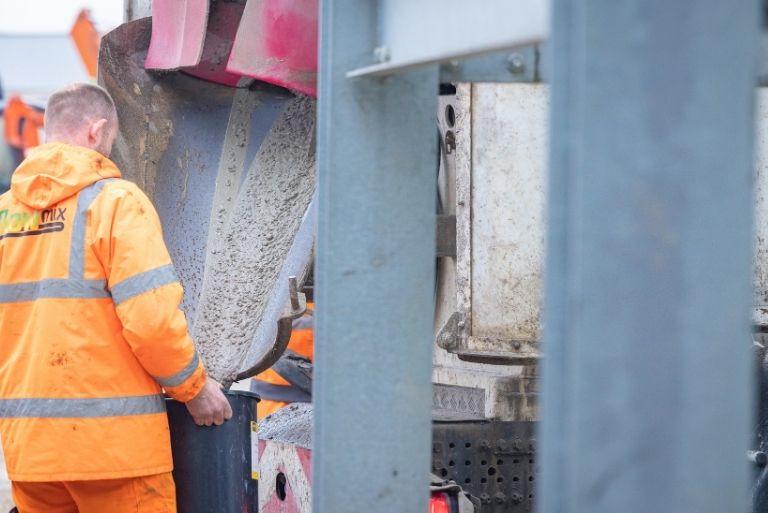
If you’ve spent any time looking into modern construction materials, you’ve probably come across GGBS concrete. A few years ago, it was something you’d only see specified on larger or specialist projects. Now, it’s becoming a more common choice across everyday builds.

With increasing pressure around sustainability, rising material costs, and a growing focus on long-term performance, builders and developers are thinking differently about the concrete they use.

GGBS concrete sits right in the middle of that change.

Order ready-mix or volumetric concrete today
Free, fast quote within 24 hours
Call, message or complete our simple online form

Flowmix Tewkesbury: Tel: 01684 217888 Flowmix Walsall: Tel: 01922 741731

What Is GGBS Concrete?

GGBS stands for Ground Granulated Blast Furnace Slag. Despite the technical name, the concept is straightforward.

GGBS is a natural byproduct of the steel manufacturing process. Instead of being treated as waste, it’s cooled, ground into a fine powder, and then used to replace a portion of the traditional cement in concrete.

Depending on the individual mix, GGBS can account for 30% to 70% of the cement content. That simple substitution changes the way the concrete performs, often for the better.

How GGBS Concrete Is Made

GGBS concrete is produced in a similar way to standard concrete, using aggregates, water, and GGBS. The difference is that part of the cement is replaced with GGBS.

The biggest benefit is that you can adjust the ratio based on the project’s needs. For example, a higher GGBS content might be used where durability is the priority, while a lower percentage could be chosen if quicker early strength is required.

For builders, GGBS doesn’t feel like an entirely different material on-site. It’s more like a refined version of something they’re already used to working with.

The Benefits of GGBS Concrete

#1: Reduced Carbon Footprint

One of the biggest reasons GGBS has gained traction is its environmental advantage. Cement production has a high carbon footprint, so reducing the amount of cement in a mix directly impacts emissions.

For developers working towards sustainability targets or planning requirements, that alone can make it an attractive option.

#2: Performance

GGBS performs exceptionally well over time. It develops strength gradually and continues to gain long after standard mixes have plateaued, resulting in a structure that can be more robust in the long run.

#3: Durability

GGBS improves resistance to sulphates and other aggressive substances, which is particularly important in groundworks, foundations, and exposed environments. Over the life of a building, this can help reduce maintenance and repair work.

#4: Easier to Work With

On-site, GGBS is generally well-received, too. The mix is often smoother and easier to place, which helps with finishing and can reduce the likelihood of defects. Visually, it produces a lighter, more consistent colour, which is useful when the concrete will be seen rather than covered.

Need Expert Advice?

Speak to the team at Flowmix Tewkesbury, Gloucestershire or Aldridge, Walsall. We are happy to help with all your concrete requirements. Contact us by email or telephone.

Flowmix Tewkesbury: Tel: 01684 217888 Flowmix Walsall: Tel: 01922 741731

Are There Any Downsides to GGBS?

The main consideration with GGBS concrete is time.

It doesn’t gain strength as quickly as traditional concrete in the early stages, especially in colder conditions. That can impact scheduling if a project is working to tight deadlines.

However, it isn’t a major concern because it can be planned around. With the right mix design and a bit of foresight, most builders find it’s a manageable trade-off for the longer-term benefits.

Where GGBS Concrete Is Commonly Used

GGBS concrete is now used across a wide range of projects. You’ll see it in everything from domestic groundworks to large commercial developments.

  • It’s particularly well-suited to foundations and slabs, where durability matters more than rapid early strength.
  • It’s a strong choice for infrastructure and any environment where the concrete is exposed to moisture, chemicals, or changing conditions.

Its versatility is part of the reason it’s becoming more widely adopted.

GGBS vs Traditional Concrete

When you compare GGBS concrete to a standard mix, the differences are less about how it’s used day to day and more about how it performs over time.

Traditional concrete tends to gain strength more quickly, which can be useful on fast-moving sites. GGBS concrete, on the other hand, is more of a long game. It offers improved durability, better resistance to environmental factors, and a significantly lower carbon footprint.

For many projects, especially those with a longer design life, that trade-off makes sense.

Why Builders and Developers Are Choosing GGBS Concrete

The construction industry cannot deny the noticeable shift in how projects are being approached.

It’s no longer just about getting materials on site quickly and keeping initial costs down. Builders and developers are thinking ahead, considering how a structure will perform over the long term.

GGBS concrete fits that mindset. It offers a way to improve durability without complicating the build process, and it helps projects move closer to sustainability targets without sacrificing quality.

In a competitive industry, those details matter. The materials used on a job reflect the standard of the work, and increasingly, GGBS concrete is being seen as the more considered choice.

That’s why GGBS is no longer just an alternative. For many, it’s becoming the default material.

How Flowmix Can Help with Your Project

Flowmix has two plants, Gloucester and Walsall. We provide the following services (with time slots):

Ready-mix concrete, mix on-site (volumetric concrete)
Traditional and liquid screed.
Concrete line pump Hire to reduce manual labour and associated costs, increase efficiency, reduce wastage and clean up.
Interlocking concrete blocks for temporary or permanent barriers.
Mini-Mix loads up to 4 cubic metres.

Flowmix holds the BSA-approved Ready Mix Concrete Kitemark KM683844, a certification that “confirms a product or service’s claim has been independently and repeatedly tested by experts” (source BSI).

Flowmix Tewkesbury: Tel: 01684 217888 Flowmix Walsall: Tel: 01922 741731

Flowmix Delivery Areas

TewkesburyWalsall Plant
Bourton-on-the-WaterAldridge
BrockworthBarton-Under-Needwood
ChalfordBirmingham
CheltenhamBrownhills
Chipping CampdenBurntwood
CirencesterBurton Upon Trent
Droitwich SpaCannock
EveshamColeshill
GloucesterDudley
Great MalvernGreat Haywood
LedburyLichfield
NewentNorton Canes
NorthleachPenkridge
PershoreRugeley
Ross-on-WyeStafford
Stow-on-the-WoldTamworth
StroudWalsall
TewkesburyWest Bromwich
WorcesterWolverhampton

Sustainable ready mix concrete? With the ever-growing focus on sustainability, you may want to know if concrete sustainability is possible.

Flowmix have two plants, Tewkesbury, Gloucestershire and Aldridge, Walsall. We do everything we can to ensure our products stay ahead with sustainability where possible.

The construction industry is changing fast, with sustainability becoming a top priority. Sustainable ready mix concrete is no longer just an option; it’s necessary. With growing concerns about carbon emissions, resource depletion, and waste management, the industry is embracing greener alternatives.

Still, what exactly is sustainable ready-mixed concrete? How are companies reducing their environmental footprint while maintaining concrete strength and durability?

In this article, we’ll explore the latest eco-friendly concrete innovations and trends shaping the future of construction.

Order ready-mix or volumetric concrete today
Free, fast quote within 24 hours
Call, message or complete our simple online form

Flowmix Tewkesbury: Tel: 01684 217888 Flowmix Walsall: Tel: 01922 741731

#1: Reducing Carbon Emissions with Green Concrete

Traditional ready mix concrete production is responsible for significant global CO₂ construction emissions.

It’s accountable for 1.5% of the UK’s total emissions and 8% globally. Experts predict that by the 2040s, concrete production could transform into a ‘carbon sink.’ (Source: ICE 2022 Report)

However, slowly, the rise of low-carbon concrete is changing the game.

  • Cement alternatives like ground granulated blast-furnace slag (GGBS) and fly ash help cut carbon emissions.
  • Carbon capture technology traps CO₂ and injects it into fresh, ready-mixed concrete, reducing its environmental impact.
  • Companies are investing in energy-efficient production methods, reducing fossil fuel reliance.

Switching to sustainable ready mix concrete helps reduce the construction industry’s carbon footprint while maintaining high performance.

#2: Recycling and Waste Reduction in Concrete Production

One of the most significant advancements in eco-friendly concrete is a switch to using recycled materials. Instead of relying on virgin aggregates, manufacturers are incorporating:

  • Recycled crushed concrete from demolished structures.
  • Industrial by-products such as silica fume and slag (a by-product of smelting or refining metal ores) replace cement content.
  • Recycled water in the mixing process to cut down on water waste.

These practices lower waste and improve the sustainability of ready mix concrete without compromising quality.

#3: Self-Healing Concrete: The Future of Durability

Cracked concrete is a major issue in construction, leading to costly repairs and reduced longevity. Fortunately, self-healing concrete is emerging as a game-changer.

  • Bacteria-infused ready mix concrete can repair small cracks by producing limestone when exposed to water.
  • Capsules of healing agents embedded in sustainable concrete release chemicals to fill cracks automatically.

By increasing durability, these innovations reduce the need for maintenance, making eco-friendly concrete even more sustainable in the long run.

#4: Energy-Efficient Concrete Mixing and Transport

Sustainability isn’t just about the material but also the process. The latest sustainable ready mix concrete trends focus on energy-efficient production and transport.

  • Electric and hybrid cement mixers are reducing fuel consumption and emissions.
  • On-demand concrete batching plants minimise waste by producing only what is needed.
  • GPS tracking in delivery trucks optimises routes, cutting down on fuel use.

By improving efficiency, the industry is making low-carbon concrete more accessible and cost-effective.

#5: The Role of Smart Technology in Sustainable Concrete

Integrating smart technology further enhances the sustainability of ready mix concrete. Digital tools help improve accuracy, reduce waste, and boost efficiency.

  • AI-powered mix designs ensure optimal material use, minimising excess.
  • Real-time monitoring sensors in concrete improve curing efficiency.
  • Automated batching systems reduce human error, ensuring consistent quality.

These advancements make eco-friendly concrete more reliable and adaptable to modern construction needs.

#6: The Rise of Geopolymer Concrete

Geopolymer concrete is an innovative, eco-friendly alternative to traditional concrete. Unlike standard ready mix concrete, which relies on Portland cement, geopolymer concrete is made using industrial by-products such as:

  • Fly ash (from coal-fired power plants)
  • GGBS (Ground Granulated Blast Furnace Slag) from steel manufacturing.
  • Silica fume or other pozzolanic materials

These materials are activated using alkaline solutions (typically combining sodium hydroxide and sodium silicate), which trigger a chemical reaction known as geopolymerization. This process forms a strong, durable binder without the need for cement, significantly reducing CO₂ emissions—by up to a whopping 80% compared to traditional concrete.

Benefits of Geopolymer Concrete

  • Lower carbon footprint – No Portland cement means reduced CO₂ emissions.
  • High durability – It has excellent resistance to fire, chemicals, and extreme weather.
  • Fast curing – Can achieve strength quickly, reducing construction time.
  • Recycling potential – It utilises industrial waste, reducing landfill impact.

With its sustainability and strength, geopolymer concrete is gaining popularity in infrastructure projects, paving the way for a greener construction industry.

Conclusion

The demand for sustainability in ready-mix concrete drives innovation in the construction industry. These trends are shaping a greener future, from low-carbon concrete and self-healing technology to smart batching and recycled materials.

By embracing eco-friendly concrete, builders and developers can reduce environmental impact without sacrificing quality or durability. As technology advances, sustainable ready mix concrete will become the new industry standard, ensuring a more responsible and resilient built environment.

How Flowmix Can Help With Your Project

Flowmix has two plants, Gloucester and Walsall. We provide the following services (with time slots):

Ready-mix concrete, mix on-site (volumetric concrete)
Traditional and liquid screed.
Concrete line pump Hire to reduce manual labour and associated costs, increase efficiency, reduce wastage and clean up.
Interlocking concrete blocks for temporary or permanent barriers.
Mini-Mix loads up to 4 cubic metres.

Flowmix holds the BSA-approved Ready Mix Concrete Kitemark KM683844, a certification that “confirms a product or service’s claim has been independently and repeatedly tested by experts” (source BSI).

Flowmix Delivery Areas

TewkesburyWalsall Plant
Bourton-on-the-WaterAldridge
BrockworthBarton-Under-Needwood
ChalfordBirmingham
CheltenhamBrownhills
Chipping CampdenBurntwood
CirencesterBurton Upon Trent
Droitwich SpaCannock
EveshamColeshill
GloucesterDudley
Great MalvernGreat Haywood
LedburyLichfield
NewentNorton Canes
NorthleachPenkridge
PershoreRugeley
Ross-on-WyeStafford
Stow-on-the-WoldTamworth
StroudWalsall
TewkesburyWest Bromwich
WorcesterWolverhampton

Ready to Book a Delivery?

Top-quality concrete, traditional or liquid screed, pump hire or precast interlocking concrete blocks delivered to suit your schedule.