
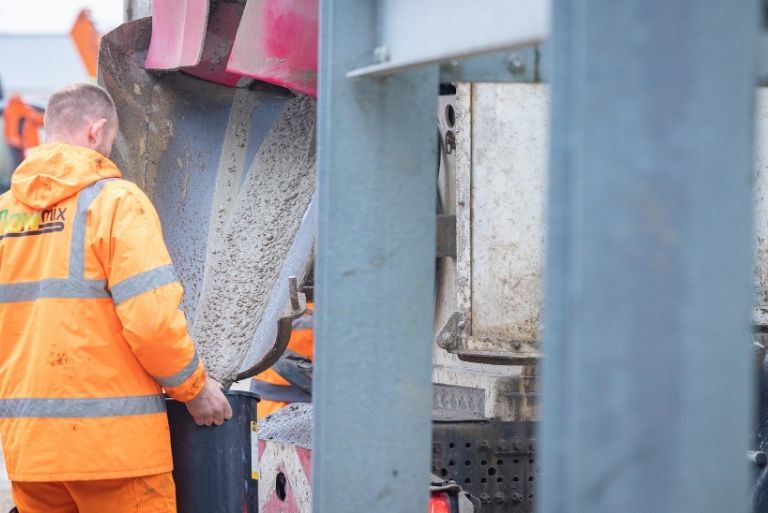
Ordering ready mix concrete shouldn’t be a challenge for homeowners. Here at Flowmix, we believe in simplifying everything for our customers as much as possible.

Home construction projects can seem like intricate puzzles – just when you think you’ve got everything figured out, a new challenge jumps out and demands your problem-solving skills.

Among the challenges, choosing the best concrete for your project can feel like solving a complex riddle that could make or break your entire project.

Suppose you’re knee-deep in a construction project, juggling a million tasks. Suddenly, concrete selection becomes the most critical decision. It’s not just about mixing wet grey stuff and hoping for the best. The type of ready mix concrete you choose can impact everything from your project’s structural integrity to long-term durability.

Ready-mixed concrete isn’t just a simple commodity – it’s a carefully engineered solution designed to meet specific construction needs. Unlike the one-size-fits-all approach many might assume, concrete comes with nuanced specifications that can dramatically influence your project’s success. Still, you don’t have to worry about that because the Flowmix team is here to remove the headaches of ordering ready mix concrete.

In this homeowner guide to ordering ready mix concrete, we’ll break down the mysteries of ready-mixed concrete and help you get the best from your ready mix concrete supplier.

Ready to Order Ready-Mix or Volumetric Concrete?

If you are ready to order a ready-mix concrete delivery, speak to the team at Flowmix Tewkesbury or Walsall. We will help you select the right mix and quantities and arrange for fast delivery to your site.

Flowmix Tewkesbury: 01684 217888 Flowmix Walsall: Tel: 01922 741731

What Do You Need Ready Mix Concrete For?

Think concrete is just, well, concrete? Think again. Construction isn’t a one-mix-fits-all industry, and ready-mix concrete is like the chameleon of building materials. It’s adaptable, specialised, and packed with potential for a multitude of projects.

Imagine ordering a custom suit. You don’t just grab something off the rack. You specify every detail. Ready-mix concrete works precisely the same way.  

Want to add some pizzazz with decorative aggregates? You know, perhaps create a driveway that becomes the envy of your neighbours. We can help guide your creative ideas into reality.

The secret sauce to your home project success is communication. Before booking the concrete truck, you’ll want to have a conversation with Flowmix, your local concrete supplier based in Tewkesbury or Walsall.

Tell us everything: colour preferences, specialist admixtures (don’t worry. We will advise on admixtures), and performance requirements.

From corrosion inhibitors to specialised accelerators, your concrete mix can be as unique as your project. It’s time to get specific, think strategically, and transform that generic grey material into a custom-engineered solution to make your construction dreams a reality.

Need Expert Advice?

Speak to the team at Flowmix Tewkesbury or Walsall. We are happy to help with all your concrete requirements.

Flowmix Tewkesbury: 01684 217888 Flowmix Walsall: Tel: 01922 741731

How to Order Ready Mix Concrete Correctly

There’s a few guidelines necessaryto ensure you get the right concrete mix at the right time for the right job. However, the Flowmix team have experience in all things concrete and will guide you step by step.

  • Calculating The Amount of Concrete Needed: Before ordering ready mix concrete, measure the depth, width and length of the space for the concrete fill. By multiplying those three measurements, you will have cubic metres (m³) volume.
    Have you already got a headache from that? If that’s the case, use the concrete calculator on this website or, even better, contact us, and we’ll do the maths for you. The Flowmix team will calculate the exact quantity of concrete needed if you have an irregularly shaped or awkward area.
  • The Project is On An Awkward Site: Don’t worry. Flowmix can offer several solutions. You may need to hire a concrete line pump if the truck can’t get near the fill site. Or, you may prefer volumetric concrete, which is mixed on site. Give us a call. We can advise.
  • Specify the Concrete Strength: Different concrete projects need different mix strengths. Flowmix can advise on this aspect of your project.
  • Concrete Density: Take into account how heavy the load will be that the concrete supports. Heavy loads require more concrete density.
  • Allow for Excess: Always allow for wastage, spillage, and spreading when ordering ready mix concrete. A typical guide is 5-10% extra. You don’t want to suddenly run out as you near the end of the project.
  • Curing Time: Weather affects concrete curing time. In hot weather, it cures quickly, weakening the mix, which can later cause cracking. As concrete cures, it becomes less workable. In cold and wet weather, curing takes longer. Talk to the Flowmix team about the best time to plan your home concrete project.
  • Cost Considerations: You don’t want any surprises, so before starting your project, contact Flowmix for a quote for ready-mix concrete.

Other Considerations for Ordering Ready Mix Concrete

Suppose your concrete project is in an awkward area. Perhaps the concrete truck cannot park near the intended concrete fill, and you dread long hours of backbreaking work pushing wheelbarrows full of wet concrete. If that’s the case, one popular alternative is to hire a concrete line pump from Flowmix. It’s 70 metres long, saves time and effort and significantly reduces the risk of spillage and wastage.

Read: Concrete Line Pump: 7 Unexpected Benefits for Your Project

Ordering ready mix concrete need not be confusing, even if it’s your first time. Our guide will hopefully help you understand the critical factors of the concrete ordering process, allowing you to choose the right type and amount of ready-mix concrete for your construction project.

How Flowmix Can Help With Your Project

Flowmix has two plants, Gloucester and Walsall. We provide the following services (with time slots):

Flowmix has the BSA-approved Ready Mix Concrete Kitemark KM683844, a certification that “confirms a product or service’s claim has been independently and repeatedly tested by experts” (source BSI).

Flowmix Tewkesbury: 01684 217888 Flowmix Walsall: Tel: 01922 741731

Flowmix Delivery Areas

TewkesburyWalsall Plant
Bourton-on-the-WaterAldridge
BrockworthBarton-Under-Needwood
ChalfordBirmingham
CheltenhamBrownhills
Chipping CampdenBurntwood
CirencesterBurton Upon Trent
Droitwich SpaCannock
EveshamColeshill
GloucesterDudley
Great MalvernGreat Haywood
LedburyLichfield
NewentNorton Canes
NorthleachPenkridge
PershoreRugeley
Ross-on-WyeStafford
Stow-on-the-WoldTamworth
StroudWalsall
TewkesburyWest Bromwich
WorcesterWolverhampton

The concrete slump test is a straightforward method used to assess the ease of flow, workability, and overall suitability of freshly mixed concrete.

It is susceptible to variations in the concrete’s consistency, producing slump measurements that range from 10 mm to 210 mm.

✅ Order ready-mix or volumetric concrete today
✅ Free, fast quote within 24 hours
✅ Call, message or complete our simple online form

Flowmix Tewkesbury: Tel: 01684 217888 Flowmix Walsall: Tel: 01922 741731

Why Do A Concrete Slump Test?

The concrete slump test ensures consistency across multiple loads or batches of the same concrete, verifying that it meets the necessary specifications. Additionally, the slump test helps detect workability problems in the mix, enabling corrections or rejections before the concrete is applied on-site.

A concrete slump test can save time and potential wastage with the many different types of concrete.

What Does ‘Slump’ Mean?

The ‘slump’ of concrete refers to its consistency before setting. Though the term might sound confusing or complex, the process is relatively straightforward. A higher slump means the concrete is more fluid than that with a lower slump.

You might find the word ‘slump’ unusual in the context of concrete, as it typically describes slouching or sinking. However, the term comes from measuring how much a heap of concrete slumps or settles when left to stand.

The concrete slump test involves filling a cone with a concrete sample, removing the cone, and then measuring how far the concrete has slumped down.

The process involves seven key steps:

  1. Position the slump cone on a smooth, level surface.
  2. Fill the cone in three layers. Compact each layer twenty-five times with a steel rod.
  3. Remove any excess concrete from the top and base of the cone.
  4. Lift the cone straight up, clearing it from the concrete.
  5. Place the cone upside down next to the concrete on the surface.
  6. Use a measuring stick to determine how much the concrete has slumped by measuring the distance from the bottom of the bar to the top of the concrete.
  7. Record the slump to the nearest 10 mm.

The concrete slump test produces one of three shapes:

  1. A True slump – whereby the concrete retains the slump shape.
  2. Shear slump – the top of the concrete shape shears off by slipping to the side or shearing away.
  3. Collapse slump – the concrete is too “wet” and simply collapses in a heap .

A slump cone test is carried out using a metal mould shaped like a frustum of a cone, with different top and bottom diameters. The cone is filled with concrete in three layers. Each layer is compacted using a steel tamping rod to ensure even distribution.

Once filled and tamped, the cone, you gently lift the cone, allowing the concrete to “slump” or settle—the vertical displacement of the concrete measures the slump value.

If the mixture is too wet, the concrete will collapse, known as a collapse slump. Conversely, if the water-cement ratio is too low, the concrete may hold its shape (true slump) or slip sideways (shear slump).

Understanding the differences between a shear, collapse, and true slump can prevent problems such as wasted concrete and other resources. Accurate slump test results ensure a construction project proceeds smoothly and without issues.

When assessing the quality of fresh concrete, the slump test is often the standard method used. This test provides crucial information about the concrete’s workability by measuring its consistency before it sets.

Read: Ordering Ready Mix Concrete Gloucester: A Homeowner’s Guide

Need Expert Advice?

Speak to the team at Flowmix Tewkesbury or Walsall. We are happy to help with all your concrete requirements.

Flowmix Tewkesbury: 01684 217888 Flowmix Walsall: Tel: 01922 741731

The Importance of the Slump Test in Construction

The concrete slump test is more than just a measurement; it indicates the concrete’s quality and workability. A concrete slump chart helps interpret these values, revealing whether the mix is too dry or too wet.

On a construction project, the slump test report informs decisions about mixing, placement, and curing, directly impacting the final structure’s integrity. For example, a mix with high workability might be suitable for road construction but inappropriate for structures requiring light reinforcement.

In conclusion, the slump test is a critical step in ensuring the quality of the concrete used is suitable for your project.

Ready to Order Ready-Mix or Volumetric Concrete?

If you are ready to order a ready-mix or volumetric concrete delivery, speak to the team at Flowmix Tewkesbury or Walsall. We will help you select the right mix and quantities and arrange for fast delivery to your site.

Flowmix Tewkesbury: 01684 217888 Flowmix Walsall: Tel: 01922 741731

What You Will Need to Do A Slump Test

When preparing to conduct a concrete slump test, the first item you’ll need is a slump cone.

This metal mould has a smaller top diameter than the bottom, resembling the frustum of a cone. The interior surface of the cone should be smooth to minimise surface friction during the test.

A base plate is also necessary, providing a surface to place the slump cone.

In addition to the slump cone and base plate, you will need a steel tamping rod to compact the fresh concrete in layers inside the cone. Ensure the rod is smooth and of the correct length. Some testing kits may include a ruler or scale to measure the slump value accurately.

Step-by-Step: Slump Cone Test Procedure

  • Ensure the slump cone and base plate are clean and free of debris or old concrete.
  • Place the base plate on a level surface and position the slump cone over it.
  • Fill the cone in three layers, each approximately one-third the height of the cone.
  • Tamp each layer 25 times using a tamping rod to compact it uniformly onto the layer below.
  • After tamping the final layer, level the concrete at the top by removing any excess.
  • Lift the cone vertically with a smooth, quick motion, allowing the concrete to slump.
  • Observe whether the result is a true slump, shear slump, or collapse slump, which indicates the concrete’s workability.
  • Measure the slump value by calculating the difference between the cone’s height and the highest point of the slumped concrete.
  • Record the slump value in your test report for future reference.

Common Mistakes and Best Practices

Conducting a concrete slump test may seem straightforward, but even small mistakes can significantly affect the results. One common error is tamping the fresh concrete too vigorously or insufficiently, distorting the slump value. It’s essential to use the tamping rod uniformly to assess the concrete’s workability accurately.

Another frequent issue is lifting the slump cone too quickly or slowly, leading to a shear or collapse slump. The speed at which the cone is removed is critical in determining the correct slump value.

If the concrete collapses completely, the mix is too wet and requires adjustment. On the other hand, a zero slump suggests that the mix is too dry and may need a revision of the water-cement ratio.

Following the standard test method and adhering to the exact slump cone procedure will provide the most accurate results. Always refer to a slump test report to compare your findings and ensure accuracy throughout the process.

The slump test is a fundamental quality control tool in the construction industry, where even minor differences can lead to significant consequences.

From understanding the meaning of concrete slump to recognising the subtle differences between shear slump and collapse slump, this test can play a crucial role in establishing the successful outcome of a concrete project.

How Flowmix Can Help With Your Project

Flowmix has two plants, Gloucester and Walsall. We provide the following services (with time slots):

Flowmix has the BSA-approved Ready Mix Concrete Kitemark KM683844, a certification that “confirms a product or service’s claim has been independently and repeatedly tested by experts” (source BSI).

Flowmix Tewkesbury: 01684 217888 Flowmix Walsall: Tel: 01922 741731

Flowmix Delivery Areas

Tewkesbury PlantWalsall Plant
Bourton-on-the-WaterAldridge
BrockworthBarton-Under-Needwood
ChalfordBirmingham
CheltenhamBrownhills
Chipping CampdenBurntwood
CirencesterBurton Upon Trent
Droitwich SpaCannock
EveshamColeshill
GloucesterDudley
Great MalvernGreat Haywood
LedburyLichfield
NewentNorton Canes
NorthleachPenkridge
PershoreRugeley
Ross-on-WyeStafford
Stow-on-the-WoldTamworth
StroudWalsall
TewkesburyWest Bromwich
WorcesterWolverhampton

Ready to Book a Delivery?

Top-quality concrete, traditional or liquid screed, pump hire or precast interlocking concrete blocks delivered to suit your schedule.