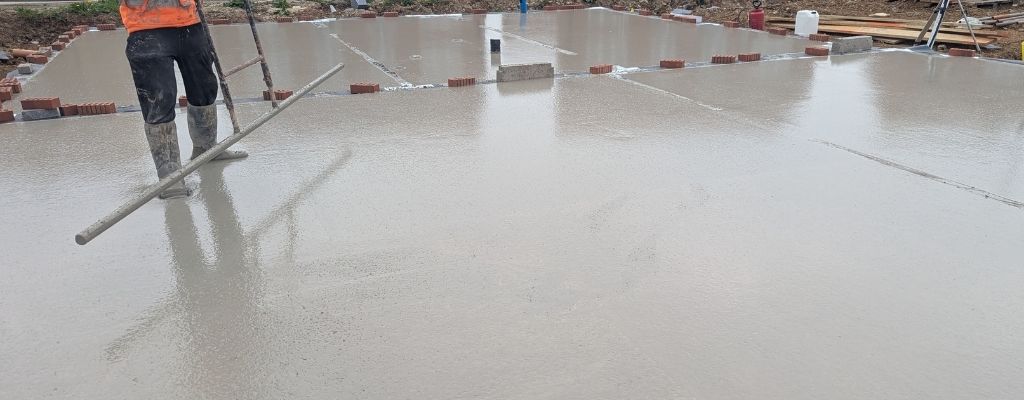
Concrete curing often seems like a mystery, but it’s not complicated.
Whether you’re installing a driveway, laying foundations, or pouring a slab, proper concrete curing ensures its strength and durability, so it performs for years.
To help you get the most from your project, this guide will outline effective techniques for concrete curing.
✅ Order ready-mix or volumetric concrete today
✅ Free, fast quote within 24 hours
✅ Call, message or complete our simple online form
Flowmix Tewkesbury: Tel: 01684 217888 Flowmix Walsall: Tel: 01922 741731
What Is Concrete Curing?
Concrete curing is the process of maintaining adequate moisture and temperature levels within freshly poured concrete to allow it to gain strength properly.
Concrete gains strength through hydration. For curing, sufficient moisture is needed in the early stages.
If concrete dries too quickly, hydration slows or stops, causing weaker concrete and defects.
Why Is Concrete Curing Important?
Proper curing is essential because concrete strengthens over several weeks. Curing maximises this process for a reliable result. Proper curing helps reduce the risks of cracking, improves durability and ensures a better surface finish.
How Long Does the Curing Process Take?
One of the most common questions people ask is how long it takes concrete to cure. The cure time varies, but general milestones help assess progress.
- Initial Setting: Fresh concrete will usually begin to set within a few hours of placement. During this stage, it’s important to protect the surface from disturbance, excessive moisture loss and extreme weather conditions.
- First 24 to 48 Hours: The first couple of days are critical for strength development. Concrete should be protected and kept moist where appropriate to support hydration.
- After Seven Days: Under normal conditions, concrete typically reaches about 70% of its intended strength within the first week. That is why many construction activities can continue after seven days, although the concrete is not yet fully cured.
- After Twenty-Eight Days: The 28-day mark is widely recognised within the construction industry as the point at which concrete reaches its specified design strength.
However, concrete can continue to gain strength beyond this period under suitable conditions.
Need Expert Advice?
Speak to the team at Flowmix Tewkesbury, Gloucestershire or Aldridge, Walsall. We are happy to help with all your concrete requirements. Contact us by email or telephone.
Flowmix Tewkesbury: Tel: 01684 217888 Flowmix Walsall: Tel: 01922 741731
Factors That Affect Concrete Curing
The following can influence how quickly and effectively concrete cures.
- Hot Weather: Heat accelerates moisture evaporation, which increases the risk of shrinkage and weaker concrete.
- Cold Weather: The cold slows hydration, and freezing can damage fresh concrete.
- Wind and Low Humidity: Wind accelerates moisture loss, especially on large slabs.
- Concrete Mix Design: Cement, water, and admixtures influence performance.
- Concrete Thickness: Thicker slabs naturally retain moisture better than thinner slabs.
Common Concrete Curing Methods
Several methods successfully cure concrete, including spraying or misting, using plastic sheeting, wet covers or blankets and applying curing compounds that form a protective membrane.
Concrete Curing Tips for Driveways, Patios & Slabs
If you’re planning a domestic or commercial concrete project, these simple tips can help improve results.
Avoid foot traffic early. Concrete looks hard after 24 hours, but strength develops beneath the surface.
On warm days, use methods that retain moisture and slow drying.
Monitor the weather before and after pouring. Extreme heat, wind, rain, and frost affect curing. It’s best to seek professional advice; Flowmix can guide you on the best times and conditions for pouring.
Conclusion
Concrete curing may not be the most visible stage of a construction project, but it’s one of the most important.
Allowing concrete to cure helps maximise strength, minimise cracking, and improve long-term durability. Whether installing a driveway, laying foundations, or pouring a commercial slab, giving proper attention to curing significantly affects the finished result.
Flowmix supplies high-quality ready-mix and mix-on-site concrete throughout Gloucestershire and the West Midlands. If you’d like advice on selecting the right concrete for your next project, our experienced team is always happy to help.
How Flowmix Can Help with Your Project
Flowmix has two plants, Gloucester and Walsall. We provide the following services (with time slots):
✅ Ready-mix concrete, mix on-site (volumetric concrete)
✅ Traditional and liquid screed.
✅ Concrete line pump Hire to reduce manual labour and associated costs, increase efficiency, reduce wastage and clean up.
✅ Interlocking concrete blocks for temporary or permanent barriers.
✅ Mini-Mix loads up to 4 cubic metres.
Flowmix holds the BSA-approved Ready Mix Concrete Kitemark KM683844, a certification that “confirms a product or service’s claim has been independently and repeatedly tested by experts” (source BSI).
Flowmix Tewkesbury: Tel: 01684 217888 Flowmix Walsall: Tel: 01922 741731
Flowmix Delivery Areas
| Tewkesbury | Walsall Plant |
| Bourton-on-the-Water | Aldridge |
| Brockworth | Barton-Under-Needwood |
| Chalford | Birmingham |
| Cheltenham | Brownhills |
| Chipping Campden | Burntwood |
| Cirencester | Burton Upon Trent |
| Droitwich Spa | Cannock |
| Evesham | Coleshill |
| Gloucester | Dudley |
| Great Malvern | Great Haywood |
| Ledbury | Lichfield |
| Newent | Norton Canes |
| Northleach | Penkridge |
| Pershore | Rugeley |
| Ross-on-Wye | Stafford |
| Stow-on-the-Wold | Tamworth |
| Stroud | Walsall |
| Tewkesbury | West Bromwich |
| Worcester | Wolverhampton |