Understanding the basics of outbuilding foundations is critical when planning a new shed, garage, or garden room. Most people think about the structure first, such as the doors, the roof, and the finish.
But the real success of your project starts below ground level.
Outbuilding foundations keep your structure stable, level, and protected from movement over time. Whether you’re building in Tewkesbury, Gloucestershire, the West Midlands, or anywhere else in the surrounding areas, getting the groundwork right is what ensures your outbuilding lasts for years, not just seasons.
Here’s what you need to know before you start.
✅ Order ready-mix or volumetric concrete today
✅ Free, fast quote within 24 hours
✅ Call, message or complete our simple online form
Flowmix Tewkesbury: Tel: 01684 217888 Flowmix Walsall: Tel: 01922 741731
Why Outbuilding Foundations Matter
The ground in the UK can be radically different from one day to the next, and even on the same day. We know that moisture causes clay soils to shrink and swell, and frost can affect shallow concrete during colder months. In addition, tree roots and poor drainage can also cause movement.
Properly installed outbuilding foundations help to:
- Protect against frost heave
- Prevent cracking and settlement
- Reduce the risk of damp problems
- Distribute the weight of the structure evenly
Even smaller timber buildings benefit from a solid base. For heavier brick or block garages and workshops, a solid foundation is critical.
In short, they’re not just a base. They’re structural protection.
Choosing The Right Type of Outbuilding Foundations
The right foundation depends on the size and weight of your outbuilding, as well as ground conditions.
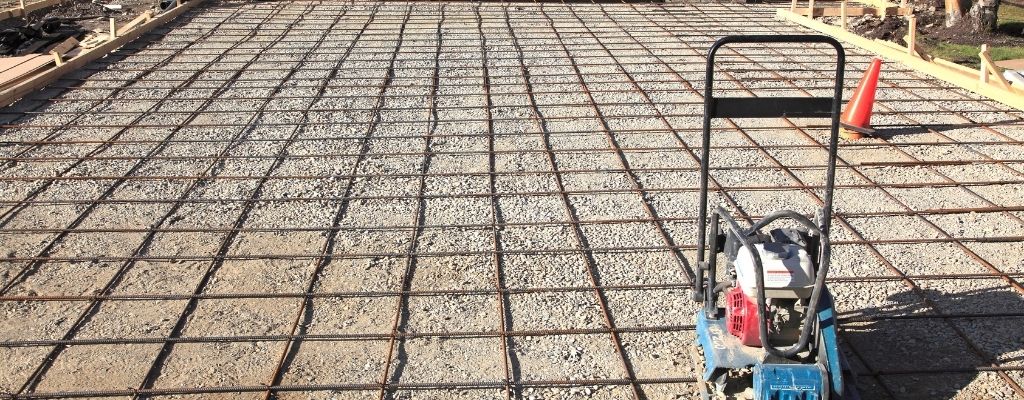
A reinforced concrete slab is one of the most popular options. It creates a strong, level surface and works particularly well for garages, garden rooms and workshops. It can also act as the finished floor.
For heavier brick outbuildings, trench fill or strip foundations are often required. These involve digging below the frost line and pouring concrete to support load-bearing walls. They’re more substantial, but necessary for larger structures.
Concrete pads can work for lightweight timber sheds, but they’re not suitable for every project. It’s important not to under-specify your outbuilding foundations to save money.
If ground conditions are uncertain, it’s always better to check before committing to a design.
How Deep Should Outbuilding Foundations Be?
In most parts of the UK, foundations are typically dug to at least 750mm deep to avoid frost issues. In clay-heavy areas or near trees, they may need to be deeper.
This is where local knowledge matters. Ground conditions can vary even within the same town. Outbuilding foundations that are too shallow can shift over time, leading to cracks or uneven floors.
If you’re unsure about soil type or load requirements, speaking to an experienced concrete supplier before you start can prevent costly mistakes later.
Need Expert Advice?
Speak to the team at Flowmix Tewkesbury, Gloucestershire or Aldridge, Walsall. We are happy to help with all your concrete requirements. Contact us by email or telephone.
Flowmix Tewkesbury: Tel: 01684 217888 Flowmix Walsall: Tel: 01922 741731
What’s Involved in Installing Outbuilding Foundations?
Although every site is different, the general process is straightforward.
The area is marked out and excavated to the required depth. A sub-base, usually compacted hardcore, is installed to create stability, and reinforcement may be added depending on the load.
Concrete is then poured, levelled and left to cure properly. That curing time is essential because rushing the process can weaken the slab and reduce the lifespan of the foundation.
For trench foundations, the concrete is poured into excavated trenches to support the walls above.
It sounds simple on paper, but precision at each stage makes all the difference.
Are Outbuilding Foundations Expensive?
Costs depend on several factors:
- Depth required
- Access to the site
- Ground conditions
- Size of the outbuilding
- Type of concrete used
A small shed base may cost a few hundred pounds. A reinforced concrete slab for a garage or garden room will cost more, especially if deeper excavation is required.
What’s important is matching the foundation to the structure. Cutting corners at this stage often leads to far higher repair costs later.
✅ Order ready-mix or volumetric concrete today
✅ Free, fast quote within 24 hours
✅ Call, message or complete our simple online form
Flowmix Tewkesbury: Tel: 01684 217888 Flowmix Walsall: Tel: 01922 741731
Common Mistakes to Avoid
One of the most common issues with outbuilding foundations is underestimating the building’s weight. Even a modest brick structure can put a significant load on the ground.
Poor drainage is another problem. Water pooling around the base can weaken the soil and cause long-term movement.
And finally, building too soon after pouring concrete is a mistake. Concrete needs time to gain strength. Patience here protects your investment.
Working With a Local Concrete Supplier
If you’re installing outbuilding foundations in Tewkesbury, Gloucestershire or the West Midlands, using a reliable local supplier like Flowmix makes the process much smoother.
Accurate concrete mixes, timely delivery within a two-hour slot, and advice based on real ground conditions all help ensure the job is done properly. Whether you need ready-mix concrete delivered or a mix-on-site solution for restricted access, planning ahead makes everything easier.
Conclusion
Outbuilding foundations may not be the most visible part of your project, but they are the part on which everything depends.
When done properly, solid foundations provide stability, protect against movement and damp, and give your shed, garage, or garden room the best possible start. Take the time to plan carefully, use the right materials and don’t underestimate the importance of what’s happening below ground.
If you’re unsure about the right concrete solution for your project, getting expert advice before you pour can save you time, money and stress.
How Flowmix Can Help with Your Project
Flowmix has two plants, Gloucester and Walsall. We provide the following services (with time slots):
✅ Ready-mix concrete, mix on-site (volumetric concrete)
✅ Traditional and liquid screed.
✅ Concrete line pump Hire to reduce manual labour and associated costs, increase efficiency, reduce wastage and clean up.
✅ Interlocking concrete blocks for temporary or permanent barriers.
✅ Mini-Mix loads up to 4 cubic metres.
Flowmix has the BSA-approved Ready Mix Concrete Kitemark KM683844, a certification that “confirms a product or service’s claim has been independently and repeatedly tested by experts” (source BSI).
Flowmix Tewkesbury: Tel: 01684 217888 Flowmix Walsall: Tel: 01922 741731
Flowmix Delivery Areas
| Tewkesbury Area | Walsall Area |
| Bourton-on-the-Water | Aldridge |
| Brockworth | Barton-Under-Needwood |
| Chalford | Birmingham |
| Cheltenham | Brownhills |
| Chipping Campden | Burntwood |
| Cirencester | Burton Upon Trent |
| Droitwich Spa | Cannock |
| Evesham | Coleshill |
| Gloucester | Dudley |
| Great Malvern | Great Haywood |
| Ledbury | Lichfield |
| Newent | Norton Canes |
| Northleach | Penkridge |
| Pershore | Rugeley |
| Ross-on-Wye | Stafford |
| Stow-on-the-Wold | Tamworth |
| Stroud | Walsall |
| Tewkesbury | West Bromwich |
| Worcester | Wolverhampton |