When you need a solid and long-lasting base for a shed, driveway, patio, or even an extension, the best solution is to lay a concrete slab. Concrete slabs are strong, versatile, and provide a level foundation that will stand the test of time.
While some people opt for the DIY route, the process requires careful planning, precision, and the right materials. Ordering ready-mix concrete from a trusted supplier like Flowmix makes the job quicker, easier, and guarantees a professional finish.
This post is a guide to laying a concrete slab if you intend on doing it yourself.
✅ Order ready-mix or volumetric concrete today
✅ Free, fast quote within 24 hours
✅ Call, message or complete our simple online form
Flowmix Tewkesbury: Tel: 01684 217888 Flowmix Walsall: Tel: 01922 741731
#1: Plan and Prepare the Area
Before you lay a concrete slab, preparation is everything. Begin by selecting the best location and measuring the area accurately. Mark the outline with wooden stakes and string to ensure straight edges and accurate dimensions.
Once you’ve marked the space, you’ll need to excavate the soil to the required depth, typically 150–200mm, depending on the intended use of the slab. Ensure the base is level and free from debris, as any unevenness can impact the strength and appearance of your concrete.
To keep the slab in place while pouring, install sturdy formwork around the edges to prevent it from shifting. You can make a form from timber boards secured firmly with pegs.
Good formwork will help maintain the shape of your slab and prevent the concrete from spreading beyond the designated area.
#2: Create a Strong Foundation
Once you’ve prepared the area, the next step in laying a concrete slab is to create a stable base. Without a solid foundation, your concrete may crack, shift, or become uneven over time.
Start by laying a sub-base of compacted hardcore or crushed stone, around 100mm deep. That provides strength and helps with drainage. Additionally, apply a thin layer of sharp sand to smooth out the surface.
If you’re using the slab for a shed foundation, patio, or driveway, it’s also wise to install a damp-proof membrane. That prevents rising moisture from damaging the concrete in the long term.
Getting the foundation right makes the process of pouring a concrete slab much easier and ensures your finished surface will stay level and durable.
Need Expert Advice?
Speak to the team at Flowmix Tewkesbury or Walsall. We are happy to help with all your concrete requirements.
Flowmix Tewkesbury: 01684 217888 Flowmix Walsall: Tel: 01922 741731
#3: Mix or Order Your Concrete
When you’re ready to lay a concrete slab, the quality of your concrete mix is crucial. You have two main options: mixing it yourself or ordering ready-mix concrete.
For smaller jobs, hand-mixing with cement, sand, gravel, and water can be effective, but achieving the perfect consistency can be challenging. It’s also time-consuming and physically demanding.
For larger projects such as a patio slab, shed foundation, or driveway, ordering ready-mix concrete is the preferred choice.
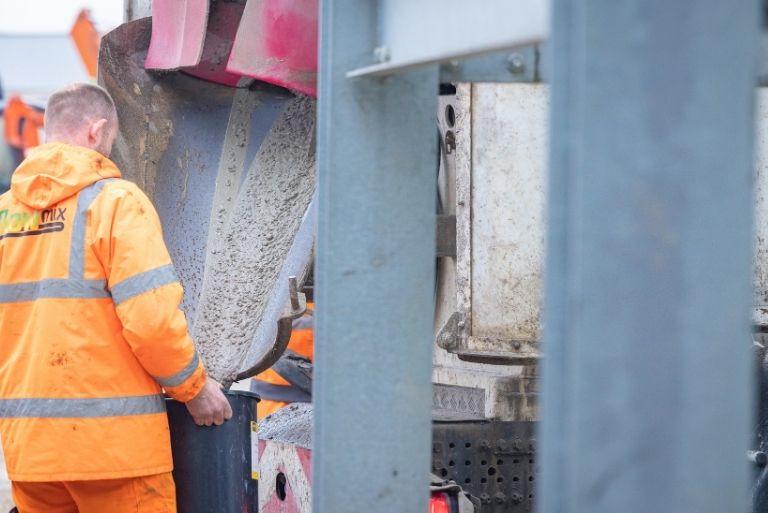
Flowmix offers both on-site mixing (volumetric) and ready mix concrete deliveries, ensuring you get precisely the right amount of concrete without waste. Our trucks can mix to your exact requirements, whether you need a stronger slab for a garage floor or a smooth finish for a garden patio.
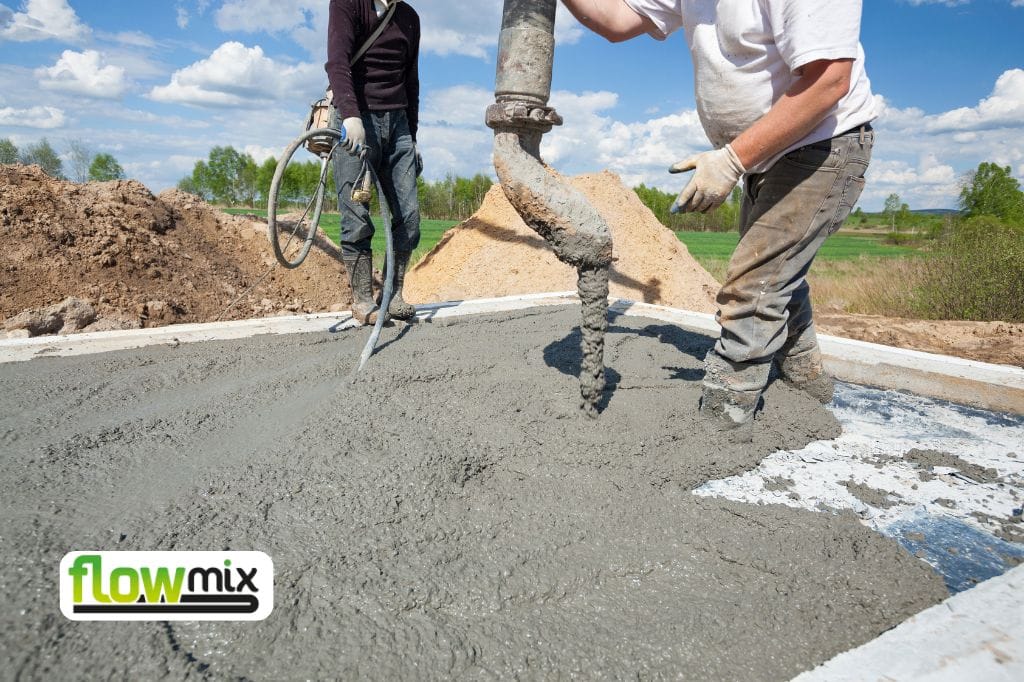
For areas with limited access, you can also arrange concrete line pump hire, which makes pouring a concrete slab into tricky spots much quicker and cleaner. A concrete pump not only saves time but also prevents the mess that often comes with the backbreaking work of hauling wheelbarrows full of concrete across the site.
#4: Pouring the Concrete
With your base prepared and your mix ready, it’s time to lay a concrete slab. Start by pouring the concrete evenly across the formwork, working from one end to the other. That helps avoid gaps and ensures complete filling of the entire area.
If you’re tackling a small shed base or garden patio, you can pour straight from the wheelbarrow. For larger slabs, such as driveways or garage floors, hiring a concrete pump can make the job much easier. A pump allows the concrete to be delivered quickly, cleanly and precisely, especially in hard-to-reach areas.
After pouring the slab, use a shovel or rake to spread the mix evenly across the surface. Make sure there are no air pockets, as these can weaken the slab. The key to pouring a concrete slab successfully is working steadily and maintaining a consistent mix throughout. A slump test is super helpful for that.
✅ Order ready-mix or volumetric concrete today
✅ Free, fast quote within 24 hours
✅ Call, message or complete our simple online form
Flowmix Tewkesbury: Tel: 01684 217888 Flowmix Walsall: Tel: 01922 741731
#5: Level and Finish the Surface
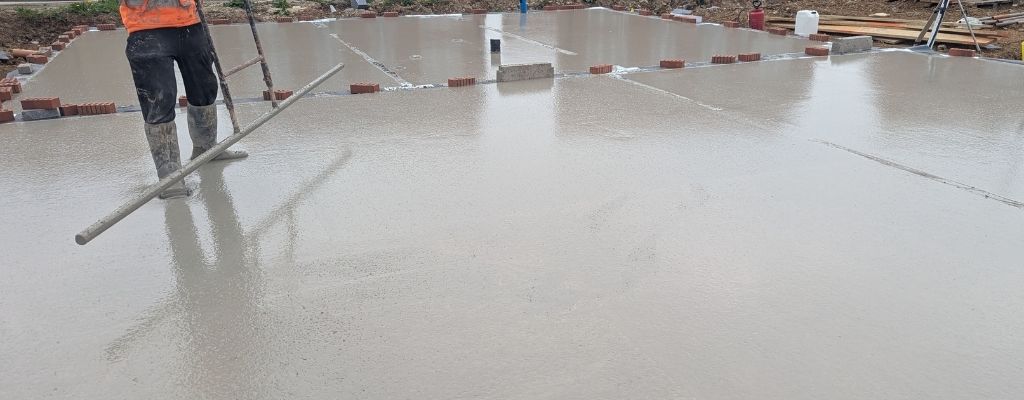
After pouring the mix, the next step is to level it. Use a straight piece of timber or a screed board to drag across the top of the formwork, moving in a sawing motion. That helps spread the concrete evenly and remove any excess.
Once the slab is level, you can smooth the surface with a float or trowel. Edging tools help create neat, defined edges that improve the slab’s appearance and reduce the chance of cracking.
If you’re laying a concrete base in an outdoor area, you might also want to create a slip-resistant finish. You can achieve this by lightly brushing the surface while it’s still wet, which provides a grip and makes it safer in wet weather. A well-finished slab not only looks good but also performs better in the long run.
#6: Curing the Slab
The final stage of laying a concrete slab is curing, and it’s one that people often overlook. Curing is the process of allowing the concrete to harden gradually so it reaches its full strength. If a slab dries out too quickly, it can shrink, crack, or become weaker than intended.
Weather conditions matter for curing. For instance, concrete can cure too fast in extreme heat or too slow in extreme cold.
After levelling and finishing, keep the surface damp by misting it with water or covering it with polythene sheeting. That slows down the drying process and helps the concrete set evenly.
Most slabs require at least 7 days of curing before they can withstand significant weight, although full strength is typically achieved after 28 days.
Patience is critical for best results. Whether you’ve poured a shed foundation, a patio slab, or a driveway, proper curing ensures your hard work pays off with a strong, durable surface that lasts for years.
Conclusion
Learning how to lay a concrete slab doesn’t have to be complicated. By carefully planning the area, creating a strong foundation, using quality concrete, pouring it evenly, levelling, finishing, and curing correctly, you can achieve a durable and professional-looking slab for any project.
Whether you’re creating a shed foundation, patio, or driveway, using Flowmix’s ready-mix concrete, on-site mixing (volumetric), and concrete line pump hire services makes the process faster, cleaner, and more reliable. With the proper preparation and the best materials, your slab will stand the test of time and provide a solid base for years to come.
If you’re ready to lay a concrete slab for your next project, contact Flowmix today to discuss your requirements and get a quote. Their experienced team will ensure you get the perfect mix and expert advice to make your project a success.
How Flowmix Can Help With Your Project
Flowmix has two plants, Gloucester and Walsall. We provide the following services (with time slots):
✅ Ready-mix concrete, mix on-site (volumetric concrete)
✅ Traditional and liquid screed.
✅ Concrete line pump Hire to reduce manual labour and associated costs, increase efficiency, reduce wastage and clean up.
✅ Interlocking concrete blocks for temporary or permanent barriers.
✅ Mini-Mix loads up to 4 cubic metres.
Flowmix has the BSA-approved Ready Mix Concrete Kitemark KM683844, a certification that “confirms a product or service’s claim has been independently and repeatedly tested by experts” (source BSI).
Flowmix Tewkesbury: 01684 217888 Flowmix Walsall: Tel: 01922 741731
Flowmix Delivery Areas
| Tewkesbury Area | Walsall Area |
| Bourton-on-the-Water | Aldridge |
| Brockworth | Barton-Under-Needwood |
| Chalford | Birmingham |
| Cheltenham | Brownhills |
| Chipping Campden | Burntwood |
| Cirencester | Burton Upon Trent |
| Droitwich Spa | Cannock |
| Evesham | Coleshill |
| Gloucester | Dudley |
| Great Malvern | Great Haywood |
| Ledbury | Lichfield |
| Newent | Norton Canes |
| Northleach | Penkridge |
| Pershore | Rugeley |
| Ross-on-Wye | Stafford |
| Stow-on-the-Wold | Tamworth |
| Stroud | Walsall |
| Tewkesbury | West Bromwich |
| Worcester | Wolverhampton |