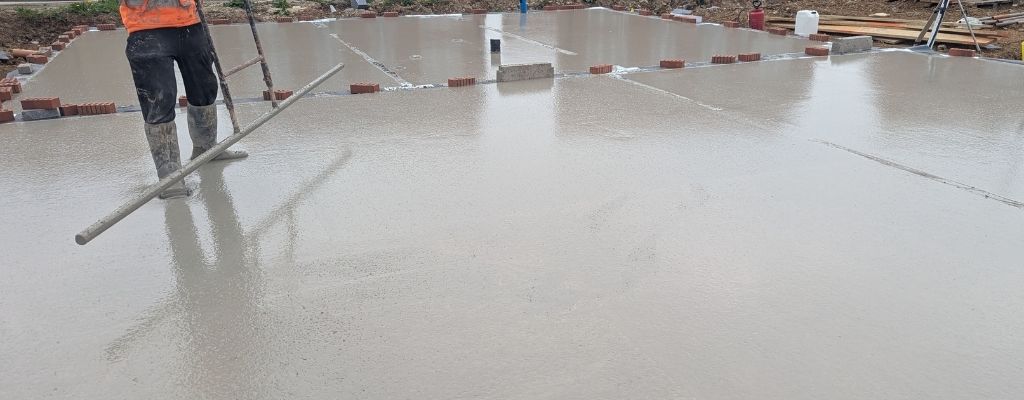
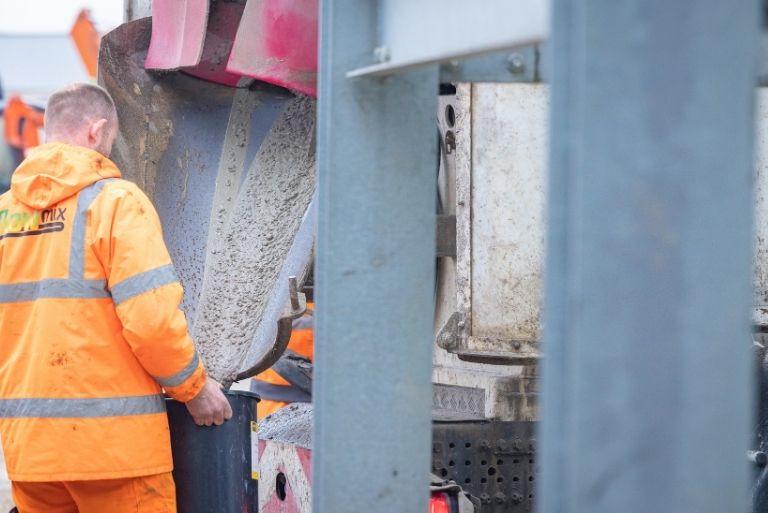
Concrete strength is vital to a concrete project’s success, safety and longevity.
Starting a project with weak concrete, especially if you’re a contractor, can weaken your reputation, as the customer will blame the contractor rather than the materials.
Even if you are a homeowner working on a small domestic project, like laying a driveway, understanding what influences concrete strength can help you do a better job.
✅ Order ready-mix or volumetric concrete today
✅ Free, fast quote within 24 hours
✅ Call, message or complete our simple online form
Flowmix Tewkesbury: Tel: 01684 217888 Flowmix Walsall: Tel: 01922 741731
#1: The Quality of Raw Materials
The quality of constituents determines the strength of the concrete
- Water-Cement Ratio: Although a high-water cement ratio makes it easier to mix and place, a higher water content can weaken the strength of the set concrete. The Flowmix team can advise on the optimum water-to-cement ratio.
- Cement: The strength of concrete improves when using high-quality cement with fewer impurities.
- Aggregates: These should be clean, hard, and free from chemicals and organic matter.
#2: The Mixing Process
Concrete strength depends on mixing thoroughly to ensure a uniform consistency. If the ingredients aren’t mixed properly, it can create pockets of weakness in the concrete.
#3: Optimum Curing Conditions
Concrete can take a long time to cure fully. It needs the right temperature, adequate moisture and time to cure to full strength. Protecting the concrete during curing is vital when experiencing extreme heat or cold conditions.
Read: How Concrete Hardens: The Science Explained in Simple Terms
#4: Admixtures
Admixtures are additives or chemicals added during the concrete mix for specific enhancements such as durability, workability, and early or final concrete strength.
If you intend to use admixtures, it’s essential to use suitable types and quantities as they can impact the strength of concrete.
Contact the Flowmix team about using the best admixtures for your concrete project.
#5: Ambient Temperature
Choosing the best time for your concrete project depends on watching the weather forecast. If it’s too hot, whilst the heat may speed up the curing process, it can weaken the overall concrete strength. If it’s too cold, that retards the curing process.
If you’re unsure about the best time to plan for your concrete delivery, the Flowmix team will provide guidance.
Need Expert Advice?
Speak to the team at Flowmix Tewkesbury or Walsall. We are happy to help with all your concrete requirements.
Flowmix Tewkesbury: 01684 217888 Flowmix Walsall: Tel: 01922 741731
#6: Compaction
A concrete mix needs to be compacted to avoid air pockets, which can reduce its strength. Correct compaction ensures a dense and strong concrete structure.
#7: Porosity and Density
As mentioned in compaction, porous concrete is weaker than dense concrete. Influencing factors are: –
- Water-cement ratio
- Compaction techniques
- Curing conditions
#8: Age of Concrete
Concrete becomes stronger as it ages, although the strengthening process slows down over time. The overall strength depends on the type of cement used and the curing conditions.
#9: Type and Duration of Load
Dynamic loads can affect the strength and longevity of concrete more than static loads, depending on the duration of the load and whether it has prolonged dynamic use.
For example, a heavy truck parked on a concrete area will cause less wear and tear than a fleet of heavy trucks driving across the concrete for eight or more hours daily.
Read: Ordering Ready Mix Concrete: A Homeowners Guide
Conclusion
When planning your concrete project, consider the factors affecting concrete strength.
Concrete is exceptionally strong and strengthens over time. Still, consider the elements affecting the strength before ordering a concrete delivery.
Whether you’re a contractor, architect or a homeowner planning to lay a concrete drive, considering all the elements can ensure the concrete structure withstands the test of time.
How Flowmix Can Help With Your Project
Flowmix has two plants, Gloucester and Walsall. We provide the following services (with time slots):
✅ Ready-mix concrete, mix on-site (volumetric concrete)
✅ Traditional and liquid screed.
✅ Concrete line pump Hire to reduce manual labour and associated costs, increase efficiency, reduce wastage and clean up.
✅ Interlocking concrete blocks for temporary or permanent barriers.
✅ Mini-Mix loads up to 4 cubic metres.
Flowmix holds the BSA-approved Ready Mix Concrete Kitemark KM683844, a certification that “confirms a product or service’s claim has been independently and repeatedly tested by experts” (source BSI).
Flowmix Tewkesbury: Tel: 01684 217888 Flowmix Walsall: Tel: 01922 741731
Flowmix Delivery Areas
| Tewkesbury Plant | Walsall Plant |
| Bourton-on-the-Water | Aldridge |
| Brockworth | Barton-Under-Needwood |
| Chalford | Birmingham |
| Cheltenham | Brownhills |
| Chipping Campden | Burntwood |
| Cirencester | Burton Upon Trent |
| Droitwich Spa | Cannock |
| Evesham | Coleshill |
| Gloucester | Dudley |
| Great Malvern | Great Haywood |
| Ledbury | Lichfield |
| Newent | Norton Canes |
| Northleach | Penkridge |
| Pershore | Rugeley |
| Ross-on-Wye | Stafford |
| Stow-on-the-Wold | Tamworth |
| Stroud | Walsall |
| Tewkesbury | West Bromwich |
| Worcester | Wolverhampton |