Uneven concrete floors cause more problems than most people realise. Tiles crack, laminate lifts at the joints, vinyl shows dips, and in garages or workshops, you might even notice water pooling in certain areas. If you plan to install new flooring or want a smoother, safer surface, learning to level a concrete floor properly is essential.
The good news is that most uneven surfaces can be corrected. The key is to understand what caused the problem and choose the right method before you start.
✅ Order ready-mix or volumetric concrete today
✅ Free, fast quote within 24 hours
✅ Call, message or complete our simple online form
Flowmix Tewkesbury: Tel: 01684 217888 Flowmix Walsall: Tel: 01922 741731
Why You Might Need to Level a Concrete Floor
Concrete rarely stays perfectly flat forever. Over time, natural settlement may create dips and ridges, or the original pour may not have been finished to a high standard. Heavy loads, such as machinery, vehicles, or storage, can also compress certain sections, leaving low spots.
Moisture can be another hidden factor. If water has penetrated beneath the slab, it may contribute to movement and cracking. Before installing tiles, engineered wood, LVT or laminate, it is especially important to level a concrete floor, so the finished surface sits properly and lasts.
Even minor imperfections can become serious issues after laying a new floor.
How To Check If a Concrete Floor Is Uneven
Before you attempt to level a concrete floor, you need to confirm the extent of the problem. For smaller rooms, a long straight edge combined with a spirit level works well. Lay it across different sections of the floor and look for gaps beneath the straight edge.
In larger spaces such as garages or extensions, a laser level can provide a clearer picture. Industry tolerances typically allow only a few millimetres of variation across a couple of metres. Anything beyond that will usually require correction, especially when installing rigid flooring materials.
You also need to determine whether you are dealing with high spots, low spots, or both. The solution will depend on this.
Methods To Level a Concrete Floor
There is no single solution that works in every situation. It largely depends on the area’s condition and degree of unevenness.
Grinding High Spots
If the issue is isolated to raised areas, mechanical grinding may be sufficient to remove small ridges and imperfections without raising the entire floor level.
Grinding is a dusty process, so be sure to take proper safety precautions, including respiratory protection and dust extraction. It is best suited to minor corrections rather than major levelling.
Using Self-Levelling Compound
For most DIY situations, self-levelling compound is the go-to solution. It is designed to flow across the surface and settle into low areas, creating a smooth, flat finish.
This is one of the most common methods for levelling concrete floors before installing tile, vinyl, or laminate. It works best for shallow dips and general unevenness rather than deep structural voids.
Applying Floor Screed
When there are larger inconsistencies across a wider area, a traditional sand-and-cement screed may be more appropriate. You can lay screed thicker than the standard levelling compound for renovations or when significant correction is required.
Screeding requires more skill and careful preparation, as the finish depends heavily on proper mixing, application, and curing.
When To Call a Professional
If there are wide cracks, slab movement, or signs of structural failure, you may need a specialist assessment. In severe cases, trying to level the concrete floor before addressing the underlying issues can lead to recurring problems.
When in doubt, professional advice is worth the cost.
Need Expert Advice?
Speak to the team at Flowmix Tewkesbury, Gloucestershire or Aldridge, Walsall. We are happy to help with all your concrete requirements. Contact us by email or telephone.
Flowmix Tewkesbury: Tel: 01684 217888 Flowmix Walsall: Tel: 01922 741731
How to Level a Concrete Floor Using Self-Levelling Compound
For moderate unevenness, self-levelling compound offers an efficient and accessible solution. The success of the project depends far more on preparation than the pour itself.
Step 1 – Prepare The Surface Thoroughly
Start by clearing the entire area. Remove old adhesives, debris, dust and grease. Concrete must be clean and sound before you attempt to level a concrete floor using any compound.
If cracks are present, repair them with an appropriate filler and allow them to cure fully. Any loose material should be removed. The compound will only perform as well as the surface beneath it.
Step 2 – Apply Primer
Primer is often overlooked, but it’s essential. It helps the levelling compound bond properly to the concrete and prevents rapid moisture absorption.
Apply the primer evenly per the manufacturer’s instructions, then allow it to dry completely. Skipping this step can result in poor adhesion or surface failure.
Step 3 – Mix The Levelling Compound Correctly
Carefully follow the manufacturer’s water-to-powder ratio. Adding too much water weakens the mixture, while too little can prevent it from flowing properly.
Mix thoroughly until smooth and lump-free. Most levelling compounds have a limited working time, so be ready to pour immediately after mixing.
Step 4 – Pour And Spread
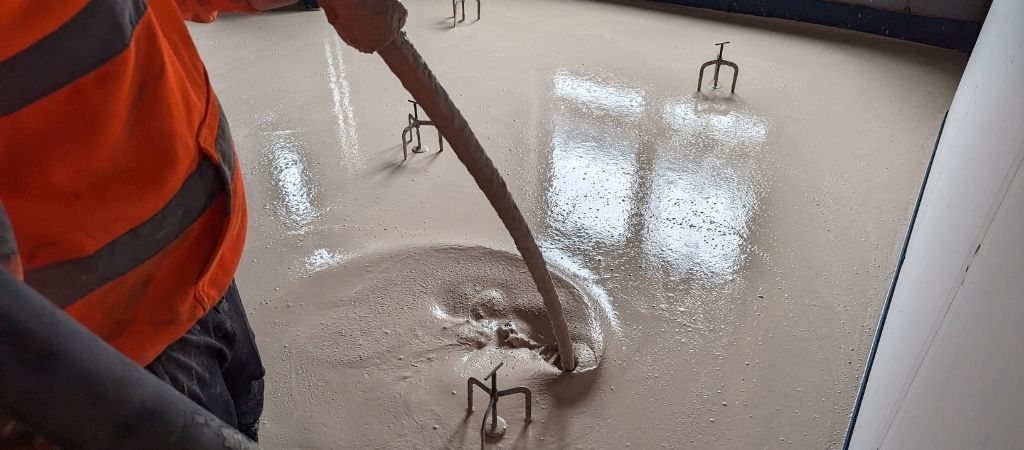
Begin pouring at one end of the room and work your way across. The compound will begin to flow and settle into low spots. You can guide it gently with a smoothing trowel or gauge rake, but avoid overworking the surface.
If necessary, use a spiked roller to remove trapped air bubbles. Work steadily and efficiently because timing matters when you level concrete floors this way.
Step 5 – Allow Proper Curing Time
Resist the temptation to walk on the surface too soon. Initial set times can be a few hours, but full curing may take longer depending on thickness and temperature.
Only install new flooring once the compound has fully cured and meets moisture requirements. Rushing this stage can undo all your effort.
Common Mistakes When Trying to Level a Concrete Floor
Multiple mistakes can happen when trying to level a concrete floor:
- Incorrect mixing ratios can compromise strength and finish.
- Skipping primer is one of the most frequent mistakes made by DIYers.
- Failing to address cracks or loose sections before pouring the compound.
Levelling products aren’t designed to fix structural movement. They create a flat surface, not structural reinforcement.
Temperature can also affect performance. Very cold or very hot environments may interfere with curing times and flow characteristics.
Understanding these pitfalls will dramatically increase your chances of success when you level a concrete floor yourself.
✅ Order ready-mix or volumetric concrete today
✅ Free, fast quote within 24 hours
✅ Call, message or complete our simple online form
Flowmix Tewkesbury: Tel: 01684 217888 Flowmix Walsall: Tel: 01922 741731
Do I Need a Professional to Level a Concrete Floor
For small to medium areas with minor unevenness, with good preparation, many homeowners successfully level concrete floors using a self-levelling compound.
However, if the area is large, the unevenness is pronounced, or there are signs of underlying structural issues, hiring a professional may be the wiser option.
Conclusion
Uneven concrete can compromise both the appearance and durability of your finished flooring. Whether you are preparing for tile, laminate, or vinyl, or simply improving a garage or workshop, taking the time to level a concrete floor properly is an investment in long-term performance.
The most important factors are accurate assessment, thorough preparation, and selecting the appropriate method based on the problem’s severity. In many cases, self-levelling compound offers a practical solution. In other cases, grinding, screeding, or professional intervention may be necessary.
Approach the task methodically, and you will achieve a smooth, stable base that supports your flooring for years to come.
How Flowmix Can Help With Your Project
Flowmix has two plants, Gloucester and Walsall. We provide the following services (with time slots):
✅ Ready-mix concrete, mix on-site (volumetric concrete)
✅ Traditional and liquid screed.
✅ Concrete line pump Hire to reduce manual labour and associated costs, increase efficiency, reduce wastage and clean up.
✅ Interlocking concrete blocks for temporary or permanent barriers.
✅ Mini-Mix loads up to 4 cubic metres.
Flowmix has the BSA-approved Ready Mix Concrete Kitemark KM683844, a certification that “confirms a product or service’s claim has been independently and repeatedly tested by experts” (source BSI).
Flowmix Tewkesbury: Tel: 01684 217888 Flowmix Walsall: Tel: 01922 741731
Flowmix Delivery Areas
| Tewkesbury Area | Walsall Area |
| Bourton-on-the-Water | Aldridge |
| Brockworth | Barton-Under-Needwood |
| Chalford | Birmingham |
| Cheltenham | Brownhills |
| Chipping Campden | Burntwood |
| Cirencester | Burton Upon Trent |
| Droitwich Spa | Cannock |
| Evesham | Coleshill |
| Gloucester | Dudley |
| Great Malvern | Great Haywood |
| Ledbury | Lichfield |
| Newent | Norton Canes |
| Northleach | Penkridge |
| Pershore | Rugeley |
| Ross-on-Wye | Stafford |
| Stow-on-the-Wold | Tamworth |
| Stroud | Walsall |
| Tewkesbury | West Bromwich |
| Worcester | Wolverhampton |