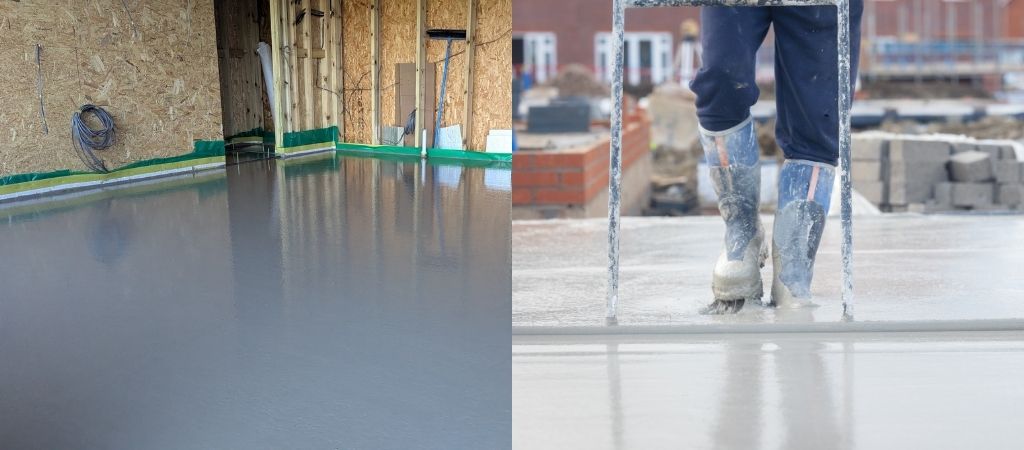
It often starts with a simple question on-site or during planning. Do you use screed or concrete? They look similar, they arrive in similar trucks, and both involve cement, but choosing the wrong one can cause delays, cracking, or costly rework later.
In this guide, we break down screeds vs concrete in plain English so you can make the right decision the first time, whether you are building from scratch, renovating, or preparing floors for final finishes.
What’s the Difference Between Screed and Concrete?
To grasp the differences between screeds vs concrete, understanding the fundamental role of each material is key to making the right choice.
Concrete is a structural material. It contains cement, water and coarse aggregates such as gravel or crushed stone. The purpose of concrete is to carry heavy loads and provide long-term strength, and it is commonly used for foundations, floor slabs, driveways, and external hardstanding.
Screed is a finishing material. It uses cement and much finer aggregates, usually sharp sand, and it’s laid in thinner layers. Screed isn’t for structural purposes. Its role is to create a smooth, level surface ready for flooring such as tiles, vinyl, laminate or carpet, and it’s the perfect choice for underfloor heating.
This difference in purpose is what really defines screeds vs concrete. One supports the building, the other perfects the surface.
✅ Order ready-mix or volumetric concrete or screed today
✅ Free, fast quote within 24 hours
✅ Call, message or complete our simple online form
Flowmix Tewkesbury: Tel: 01684 217888 Flowmix Walsall: Tel: 01922 741731
When Screeds Are the Better Choice
Creating a Smooth, Level Floor
If your priority is achieving a flat, even surface, screed is usually the right option. After installing a concrete sub-base, the screed is the top layer that removes imperfections and provides a clean finish for the final floor coverings.
Ideal for Underfloor Heating
Screed is the best option for underfloor heating systems. Liquid screed in particular flows easily around heating pipes, reducing air gaps and helping heat distribute evenly across the room. That makes it a popular choice for modern homes and extensions.
Faster Drying for Tight Schedules
Many screeds are walkable within 24 to 48 hours, enabling follow-on trades to continue sooner, which can be critical on projects with tight timelines.
Best for Internal Use
The primary use of screed is for internal environments where a final floor finish will protect it. While you can use screed in wet areas like kitchens and bathrooms, it’s not suitable for exposed outdoor conditions on its own.
There are different types of screed, and Flowmix provides the following:
- Gyvlon Liquid Screed: Gyvlon is suitable for floating, unbonded, or bonded construction and is perfect for underfloor heating applications.
Learn about Gyvlon Liquid Screed. - Cemfloor Liquid Screed: This fast-drying and self-levelling screed is ideal for underfloor heating. It is compatible with all floor covering products and adhesives.
Learn about Cemfloor Liquid Screed. - Traditional screed: A dry mix of sand and cement at a typical ratio of one part cement to four parts sand.
Learn about Traditional Screed.
Need Expert Advice?
Speak to the team at Flowmix Tewkesbury, Gloucestershire or Aldridge, Walsall. We are happy to help with all your concrete requirements.
Flowmix Tewkesbury: Tel: 01684 217888 Flowmix Walsall: Tel: 01922 741731
When Concrete Is the Better Option
Concrete is one of the most in-demand materials on the planet. We take for granted how much we rely on concrete for every structure in our lives.
Structural Strength and Load Bearing
Concrete is the clear winner where strength matters. Its job is to support weight, resist compression and provide a stable base for buildings, machinery and vehicles.
External and Heavy-Duty Applications
For driveways, garages, workshops and industrial floors, concrete offers durability that screed cannot match. It performs far better in changing weather conditions and under repeated heavy use.
Long-Term Durability
Concrete gains strength over time and, when installed correctly, can last for decades with minimal maintenance, making it ideal for permanent structural elements.
When comparing screeds vs concrete, concrete is the backbone, while screed is the finishing touch.
Screeds vs Concrete: Key Differences at a Glance
| Feature | Screed | Concrete |
| Primary purpose | Levelling and finishing | Structural support |
| Typical thickness | 25 to 75mm | 100mm or more |
| Aggregate size | Fine sand | Coarse stone and gravel |
| Strength | Lower | High |
| Best for | Internal floors, underfloor heating | Foundations, slabs, outdoor use |
| Drying time | Faster initial set | Slower, strength develops over weeks |
Do You Ever Use Both?
In many projects, the answer is yes.
A common approach is to install a concrete base first to provide strength and stability, then apply a screed layer on top to achieve a smooth, level finish. This combination delivers the best of both worlds in residential and commercial builds.
Understanding screeds vs concrete helps avoid the mistake of using one where the other is needed.
Which Should You Choose?
Choose screed if:
- You need a perfectly level surface for flooring
- You are installing underfloor heating
- The area is internal and non-structural
- Speed and finish quality are priorities
Choose concrete if:
- Structural strength is required
- The area will carry heavy loads
- The surface is external or exposed
- Long-term durability is essential
Conclusion
Screed and concrete are not interchangeable, but they work best when used together for the right reasons. Concrete provides the strength that holds everything up, while screed delivers the finish that makes a space usable and attractive.
By understanding the fundamental differences between screeds vs concrete, you can make informed decisions, avoid unnecessary costs, and ensure your project performs as it should for years to come.
If you are unsure which option suits your project, speaking to a local concrete and screed supplier can help you choose the most efficient and cost-effective solution.
How Flowmix Can Help With Your Project
Flowmix has two plants, Gloucester and Walsall. We provide the following services (with time slots):
✅ Ready-mix concrete, mix on-site (volumetric concrete)
✅ Traditional and liquid screed.
✅ Concrete line pump Hire to reduce manual labour and associated costs, increase efficiency, reduce wastage and clean up.
✅ Interlocking concrete blocks for temporary or permanent barriers.
✅ Mini-Mix loads up to 4 cubic metres.
Flowmix has the BSA-approved Ready Mix Concrete Kitemark KM683844, a certification that “confirms a product or service’s claim has been independently and repeatedly tested by experts” (source BSI).
Flowmix Tewkesbury: Tel: 01684 217888 Flowmix Walsall: Tel: 01922 741731
Flowmix Delivery Areas
| Tewkesbury Area | Walsall Area |
| Bourton-on-the-Water | Aldridge |
| Brockworth | Barton-Under-Needwood |
| Chalford | Birmingham |
| Cheltenham | Brownhills |
| Chipping Campden | Burntwood |
| Cirencester | Burton Upon Trent |
| Droitwich Spa | Cannock |
| Evesham | Coleshill |
| Gloucester | Dudley |
| Great Malvern | Great Haywood |
| Ledbury | Lichfield |
| Newent | Norton Canes |
| Northleach | Penkridge |
| Pershore | Rugeley |
| Ross-on-Wye | Stafford |
| Stow-on-the-Wold | Tamworth |
| Stroud | Walsall |
| Tewkesbury | West Bromwich |
| Worcester | Wolverhampton |