The construction world is changing fast, and one breakthrough has everyone talking. 3D concrete printing is a high-tech, game-changing method that could completely reshape how we build.
Imagine entire buildings created layer by layer with incredible accuracy, no scaffolding, no moulds, and far less waste. Sounds futuristic? Yes, of course, but it’s already happening. 3D concrete printing uses massive printers to “print” structures directly from digital designs, opening the door to quicker, smarter, and more sustainable construction.
But here’s the big question: is 3D concrete printing just a passing trend, or are we looking at a rapid shift in the future of the construction industry? As technology advances at an ever-increasing pace, do you agree it might be silly to ignore such innovation coming to the construction industry?
In this article, we’ll explore how 3D concrete printing works, its advantages and limitations, and whether it genuinely has the potential to revolutionise the way we build. Whether you’re in the industry or simply curious about cutting-edge technology, this deep dive will give you a clear picture of what’s next for construction.
Let’s look closer at what makes 3D concrete printing so exciting, and why it might be more than just a buzzword.
How 3D Concrete Printing Works
So, how does 3D concrete printing actually work? It might sound like something out of a sci-fi film, but the process is surprisingly straightforward once you understand the basics.
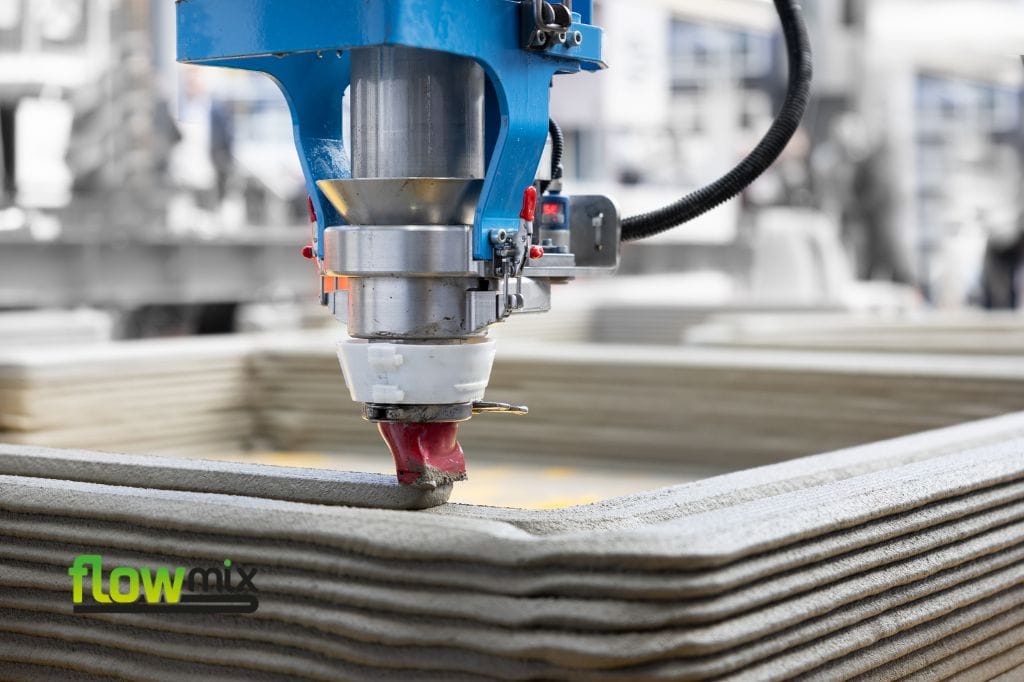
3D concrete printing is an additive manufacturing process. That means instead of pouring concrete into moulds like in traditional construction, it builds up a structure layer by layer, just like a regular 3D printer, but on a significantly larger scale. Think of it as piping icing onto a cake, except the “icing” is a specially formulated concrete mix, and the “cake” is a house, a wall, or even a bridge.
The process starts with a digital design. Architects and engineers create a 3D model of the structure using computer-aided design (CAD) software. This file gets fed into the printer, which reads the design and begins the building process—no manual labour needed.
A robotic arm or gantry system moves in multiple directions, extruding the concrete in precise lines. Because the printing process is automated and computer-controlled, the level of detail and accuracy is incredibly high. It can even handle complex curves and overhangs that would be difficult, expensive, or time-consuming to achieve with traditional methods.
The concrete used in the printing process isn’t your average cement mix. It’s engineered to flow smoothly through the printer and still set quickly enough to support the next layer. That means walls can be printed in hours, not days, without waiting for traditional curing times between stages.
Some systems also include reinforcement strategies, like inserting rebar or fibres during the print, to ensure structural strength. Others incorporate insulation or finishing elements into the printing process, reducing the need for additional trades later.
In short, 3D concrete printing takes a digital idea and turns it into a full-scale physical structure with incredible speed and precision. It’s not just a fancy gimmick—it’s a profound shift in how we approach construction.
Common Uses Include:
- Bridges
- Retaining walls
- Decorative facades
- Houses and buildings
- Urban furniture (e.g., benches, planters)
And we’re only just scratching the surface. Next, let’s look at the benefits that have led builders and developers to pay close attention to this rapidly growing technology.
How It Works in Brief:
- Digital Model: A 3D digital model (CAD file) of the structure is created.
- Layered Printing: A robotic arm or gantry system extrudes layers of concrete to match the design.
- Material: The concrete is usually a quick-setting, pumpable mix with additives for better flow, strength, and bonding.
8 Benefits of 3D Concrete Printing
There’s a reason 3D concrete printing generates so much buzz. It offers some serious advantages over traditional construction methods. From cutting costs to pushing the boundaries of design, here are some of the biggest benefits:
1. Faster Construction Times
3D concrete printing dramatically reduces build time. Structures that would typically take weeks or even months to complete can be printed in just a few days. Some houses have been printed in under 24 hours! Because the process is automated, it runs continuously without delays caused by weather, labour shortages, or material handling.
Consider the cost savings of months of manual labour that this process represents.
2. Lower Labour Costs
Traditional construction requires large teams of skilled workers. With 3D concrete printing, much of the manual labour is replaced by machines, meaning fewer workers are needed on-site. This process cuts costs and reduces the risk of injury, making it a safer option.
3. Design Freedom and Flexibility
Curves, arches, intricate facades—what used to be expensive and complex is now simple with 3D concrete printing. It allows architects to think beyond straight lines and right angles, unlocking endless possibilities for creative, innovative design.
4. Reduced Material Waste
Conventional construction is known for producing a lot of waste. With 3D concrete printing, materials are used much more efficiently. The printer deposits only what’s needed, precisely where it’s needed, drastically cutting down on excess concrete and scrap.
5. Sustainability
Because this process uses fewer resources and produces less waste, 3D concrete printing is a more environmentally friendly option. Many developers are also experimenting with eco-friendly concrete mixes, further reducing construction projects’ environmental footprint.
6. Greater Precision and Consistency
Human error can lead to costly mistakes on a building site. 3D concrete printing eliminates much of this risk. It follows the digital design with millimetre-level accuracy, ensuring consistency throughout the build and reducing the need for rework.
7. Potential for Affordable Housing
With its speed and cost-efficiency, 3D concrete printing has enormous potential in tackling the global housing crisis. Countries like India, the Netherlands, the US and some African nations are exploring 3D printing to quickly build low-cost, durable homes, offering a real solution for communities in need.
8 Challenges of 3D Concrete Printing
Of course, not everything about 3D concrete printing is rosy. While the process holds incredible promise, there are challenges like any emerging technology.
1. High Initial Costs
Although 3D concrete printing can save money in the long run, the upfront investment is significant. The machines, software, and setup required can be costly, especially for smaller contractors or developers who aren’t ready to commit to new technology.
2. Limited Availability of Materials
Not all concrete mixes are suitable for printing. 3D concrete printing requires specially formulated concrete that is suitable for pumping, capable of being extruded, and setting quickly. These mixes can be complex to source and more expensive than standard materials, particularly in remote areas.
3. Regulatory and Building Code Barriers
In many regions, building regulations haven’t caught up with the technology. 3D concrete printing structures may not meet local codes, and approval processes can be slow or unclear. That makes it harder to roll out large-scale projects, especially in urban environments.
4. Structural Limitations
While 3D concrete printing is excellent for walls and external shells, other components—like roofs, windows, plumbing, and electrical systems—still require traditional construction methods. This hybrid approach can complicate planning and reduce some of the efficiency gains.
5. Skilled Technicians Still Needed
Even though the technology reduces demands for manual labour, 3D concrete printing still relies on skilled technicians to operate the machines, maintain the equipment, and manage the software. There’s currently a skills gap in the workforce regarding this specialised knowledge.
6. Size and Mobility Constraints
The printers used in 3D concrete printing are massive and not always easy to transport. That challenge limits their use to larger building sites or requires a time-consuming setup when moved from one location to another.
7. Weather Sensitivity
Because 3D concrete printing often happens outdoors, weather conditions can affect printing. Rain, extreme temperatures, or strong winds can interfere with layer bonding or cause delays, just like in traditional construction.
8. Public and Industry Scepticism
Despite its benefits, some in the industry remain cautious about 3D concrete printing. Concerns around durability, long-term performance, and lack of widespread testing make investors and builders hesitant to adopt it at scale, or at least for now.
Although these challenges are real, they’re not insurmountable. Engineers, architects and tech innovators worldwide are already tackling the issues. As the technology matures, 3D concrete printing is likely to become more accessible, more reliable, and more widely accepted. Remember, when computers first manifested, they took up an entire room. Now, we practically carry one in our mobile phones.
Next, let’s look at the real-world applications proving just how powerful 3D concrete printing can be.
Need Expert Advice?
Speak to the team at Flowmix Tewkesbury or Walsall. We are happy to help with all your concrete requirements.
Flowmix Tewkesbury: 01684 217888 Flowmix Walsall: Tel: 01922 741731
Real-World Applications of 3D Concrete Printing
3D concrete printing isn’t just an idea for the future. It’s already being used globally in pretty exciting ways. From affordable housing to architectural showpieces, the technology is proving its worth in the real world.
Affordable Housing Projects
Perhaps one of the most potent uses of 3D concrete printing is its potential to solve housing shortages. In countries like Mexico, India, and the Netherlands, they built entire communities of printed homes to provide safe, low-cost housing. These projects demonstrate how the technology can deliver speed, quality, and cost-efficiency where needed most.
Disaster Relief Shelters
After natural disasters, there’s often an urgent need for quick, durable shelter. It’s possible to deploy 3D concrete printing to create solid structures within hours, offering a faster alternative to tents or temporary wooden buildings. These printed shelters enable a design to withstand future disasters like floods or earthquakes.
Eco-Friendly Construction
In Dubai, a full-size 3d-printed office building was completed in just 17 days! The project used less labour and created less waste than traditional builds, showcasing how 3D concrete printing can support sustainable development goals.
Innovative Architecture
Designers are using 3D concrete printing to explore new frontiers in architecture. Complex curves, sweeping walls, and futuristic facades that would be nearly impossible or incredibly expensive with traditional techniques are now achievable. One standout example is a stunning 3D-printed bridge in the Netherlands, made entirely from reinforced concrete.
Military and Defence
Even the military is getting involved. The US Army has tested 3D concrete printing to build barracks and bunkers directly on-site. These printed structures reduce the need to transport materials in dangerous zones and speed up the construction of secure facilities.
Commercial and Retail Spaces
Retailers and developers are experimenting with printed pop-up shops and kiosks. It’s possible to build these temporary spaces quickly. They can be moved easily and customised in design, perfect for seasonal promotions or events.
From simple homes to high-concept designs, 3D concrete printing is already making waves across the construction world. And as technology improves, its range of applications will only continue to grow.
Conclusion
So, is 3D concrete printing the future of construction? It’s certainly starting to look that way.
While it’s not without its challenges, the benefits are hard to ignore:
- Reduced costs
- Faster build times
- Sustainable materials
- The freedom to create bold, innovative designs.
Around the world, we’re already seeing printed homes, bridges, and buildings becoming a reality, not just a concept. As the technology evolves, it will become accessible and affordable, it could revolutionise how we think about building everything from affordable housing to skyscrapers.
Of course, we’re still in the early stages. There are questions to answer, regulations to catch up on, and mindsets to shift. But the momentum is undeniable with so many success stories already in motion.
How Flowmix Can Help With Your Project
FlowFlowmix has two plants, Gloucester and Walsall. We provide the following services (with time slots):
✅ Ready-mix concrete, mix on-site (volumetric concrete)
✅ Traditional and liquid screed.
✅ Concrete line pump Hire to reduce manual labour and associated costs, increase efficiency, reduce wastage and clean up.
✅ Interlocking concrete blocks for temporary or permanent barriers.
✅ Mini-Mix loads up to 4 cubic metres.
Flowmix holds the BSA-approved Ready Mix Concrete Kitemark KM683844, a certification that “confirms a product or service’s claim has been independently and repeatedly tested by experts” (source BSI).
Flowmix Delivery Areas
| Tewkesbury | Walsall Plant |
| Bourton-on-the-Water | Aldridge |
| Brockworth | Barton-Under-Needwood |
| Chalford | Birmingham |
| Cheltenham | Brownhills |
| Chipping Campden | Burntwood |
| Cirencester | Burton Upon Trent |
| Droitwich Spa | Cannock |
| Evesham | Coleshill |
| Gloucester | Dudley |
| Great Malvern | Great Haywood |
| Ledbury | Lichfield |
| Newent | Norton Canes |
| Northleach | Penkridge |
| Pershore | Rugeley |
| Ross-on-Wye | Stafford |
| Stow-on-the-Wold | Tamworth |
| Stroud | Walsall |
| Tewkesbury | West Bromwich |
| Worcester | Wolverhampton |